

This one is for owners of home service companies who are trying to decide who should run their marketing: an agency, a freelancer, or themselves. I run an agency, so you’d expect me to say “hire an agency.” For some of you, I won’t. Inside: what each option really costs in dollars and in hours, the budget where an agency starts paying for itself, the red flags of cheap agencies, and a two-minute test that makes the choice obvious.
In this article
- Sound familiar?
- What each option really costs
- What makes sense at your budget
- Red flags of a cheap agency
- Freelancer, agency or me
- The honest path: start yourself, hand it off later
- Two-minute test: which path is yours
- Who I am and why I do this
- When you’re ready to hand it off
- Who this won’t work for
- Questions owners ask
Sunday night, kitchen table. One tab has an agency proposal: “$1,500 a month plus ad spend.” Another has a freelancer profile at $30 an hour. A third is a YouTube video called “Google Ads for Contractors in 20 Minutes.” Your wife asks if you’ve decided. You haven’t. The agency feels like a big bet. The freelancer feels like a coin flip. And doing it yourself means doing it after 7 p.m., after a ten-hour day on site.
Here’s what most people selling marketing won’t tell you: for some owners, an agency is a bad buy right now. Mine included. For others, doing it yourself is the most expensive option on the table — it just doesn’t send an invoice. Sounds like a sales trick? The numbers are below, and you can check where you land yourself.
Sound familiar?
💸Scared to spend it and not get it back
- The agency wants $1,500 a month to manage, plus the same again for ads. You do the math: that’s several days of your crew’s labor. What if it doesn’t bring a single extra job?
- You’ve already paid for this lesson once: a $3,000 website nobody finds on Google, or an “ads guy” who went quiet in the middle of busy season.
- A buddy signed a 12-month agency contract and spent half of it fighting to get access to his own ad account.
⏰No time to learn it yourself
- You open a tutorial after dinner and wake up twenty minutes later with the phone on your chest.
- Saturdays are estimates, Sundays are quotes and invoices. There’s no slot in the week labeled “learn Google Ads.”
- You’re afraid of setting it up wrong and burning in a week the money you’d set aside for materials.

🤔No idea who to believe
- One guy says “never do it yourself, you’ll wreck it.” Another says “agencies are a scam, just learn it.”
- Quotes range from $300 to $5,000 a month, and every single one promises “more leads.”
- It’s uncomfortable to admit the business can’t carry an agency yet — like it says something about you.
What each option really costs
Most owners compare the sticker: $1,500 for the agency, $30 an hour for the freelancer, $0 for doing it yourself. But every option has three line items — the fee, the ad spend, and your time. The third one is often the biggest, it just never shows up as an invoice.
Agency: “hand it off and forget it”
The fee. With me it starts at $220 a week per channel — about $950 a month — plus a one-time launch fee. Across the market, small businesses spending $1,000–5,000 a month on ads typically pay $500–2,000 a month for management (OuterBox pricing guide, 2026). On top of that is ad spend, which you pay directly to Google or Meta; with me that starts at $1,000 a month per channel.
And you can’t fully forget it. An agency brings people to you, but you still run the estimate, write the quote, and someone still has to pick up the phone at 6 p.m. Plan on an hour or two a week: a check-in call, the report, approvals.
Freelancer: “I’ll find someone on Upwork”
According to Upwork, the median rate for a paid-ads specialist there is about $30 an hour, typically $20–45. Cheap. But a freelancer handles their piece — the ad account, the ads — and that’s where their job ends. Who answers the lead at 9:40 p.m., who follows up after the quote, who fixes the page the ads send people to? You. You become the project manager. And if your freelancer disappears in July, you start over in the busiest month of the year.

DIY: “YouTube is free”
Free on paper. In practice you pay tuition with ad spend: every setup mistake is a few hundred dollars spent on people who were never going to hire you. Most tutorials teach which buttons to click, not why a homeowner should pick you over the cheaper guy. You’ll find the buttons. Nobody will write your reason-to-choose-you for you.
And then there’s time. Learning and running it yourself means several hours a week, more in the first month.
What makes sense at your budget
My rule is simple. Don’t start from revenue — start from two numbers: how much you can comfortably put into marketing each month, ad spend included (not your last dollar), and how many free hours you really have each week.
- Just starting out or revenue is lumpy, under $1,000 a month for marketing. You don’t need an agency yet — not mine, not anyone’s. If half your budget goes to management fees, there’s almost nothing left for ads. Do the basics yourself: your Google Business Profile, reviews, fast replies, simple text templates, maybe a small test campaign.
- $1,000–2,000 a month. The gray zone. If you have a few hours a week, keep doing it yourself and put the money into ads, not fees. A freelancer for a one-time setup can make sense here. If you have zero hours, an agency on one channel can work, but be honest with yourself: it will pay back slower, and it works best when your profit per job is high.
- $2,000+ a month including ad spend, and no time. This is where an agency starts paying for itself: the fee is a reasonable share of the budget, and your hour on a job is worth more than your hour in an ad account.
- $2,000+ a month, and you actually enjoy figuring things out. Either works. Plenty of owners learn the basics first so they understand how it all fits together, then hand off management once their time gets more expensive.
And one more filter: profit per job. Roughly speaking, on a $40,000 kitchen remodel an agency can pay for itself with one signed job a quarter. On a $180 house cleaning, it needs dozens of jobs, and the math has to be done very carefully.
Red flags of a cheap agency
The most expensive mistake here isn’t “DIY instead of an agency.” It’s a cheap agency. $300 a month for management sounds like a fair middle ground: not doing it yourself, not paying much. But at that price someone has to juggle dozens of clients at once, and the easiest way to look good is a single number — cost per lead.
That’s where the race for cheap leads starts. The ads get tuned for “lots and cheap,” and the report says 80 leads at $15. In real life one person was price-checking five contractors, one lives a hundred miles away, and one was looking for a job, not a contractor. A couple of jobs, maybe. It was only cheap on paper.

I do it the other way around. Your ads, website and Google profile should show what makes your company worth the money: the work you do, how the job runs, what’s included, your warranty, what customers say. Then the people who reach out want results, not the lowest bid. You may get fewer leads, and each one may cost more — but they book estimates and sign. The number that matters is cost per job, not cost per lead.

Freelancer, agency or me
- A freelancer is great for a defined task: set up an account, build a landing page, clean up ads. Not so great when you need a system. They own their piece, not your jobs, and tying ads, lead replies and quotes together is still on you.
- A typical agency has a team and processes, but you talk to an account manager while someone you never meet does the work. Account managers rotate, reports often stop at leads, and what happens after the lead comes in usually isn’t their department. A good agency can save you years — just vet it before you pay.
- Me. I work alone — no account managers, no junior team — with an AI toolkit for speed. I own more than the ads: instant replies, call scripts, follow-up, and a report in jobs. You pay by the week with no contract: tell me by Friday and next week isn’t billed, and you get every login and file within 3 business days. Your website, domain, ad accounts and customer list are in your name from day one. I don’t promise lead counts. And if your budget is under $2,000 a month, I’ll tell you to start on your own first.
The honest path: start yourself, hand it off later
If you’re on the fence, here’s the order I recommend to most owners who are just starting to market on their own. Each step pays for the next.
- Stop losing the leads you already get — missed-call text-back, reply templates, follow-up after every quote. Cheap, and it pays for itself with the first lead that would have gone to someone else.
- Google Business Profile and reviews — so people nearby find you and pick you on reviews, not on price.
- A small first campaign — with a stop rule: decide in advance what a lead is allowed to cost before you pause it.
- Know your numbers — cost per lead, how many book an estimate, cost per job. Once you have them, no “80 leads at $15” report will impress you again.
- Hand it off — when your budget hits $2,000+ a month and your time is worth more on jobs, hand management to an agency. You’ll know what you’re paying for and judge the work by jobs, not reports. Everything you built stays yours.

Two-minute test: which path is yours
Answer yes or no
- Can you put $2,000+ a month into marketing, ad spend included, without it being your last dollar?
- Is your profit per job over $1,000?
- Do you have fewer than three free hours a week for marketing?
- Do you already get leads, and does someone reply to them within an hour?
- Do ad dashboards bore you, and you’d rather never open one?
4–5 yes — hire an agency: your time is worth more and the budget supports it. 2–3 — the gray zone: start with the basics yourself, and on a free call we’ll work out when handing off makes sense. 0–1 — do it yourself for now: an agency would eat the money that should go into ads.
Who I am and why I do this

I’m Eddie A. For 12+ years I’ve worked in marketing and sales: projects in 50+ industries, ad budgets up to $60,000 a month, and $12M+ in revenue attributed to campaigns I managed — in the U.S., Canada, the UAE, Turkey, Europe and Kazakhstan. I’m based in Apopka, Florida, and run a registered LLC.
- 12+years in marketing and sales
- 50+industries I’ve run ads for
- $60Kmax monthly ad budget
- $12M+revenue from my campaigns
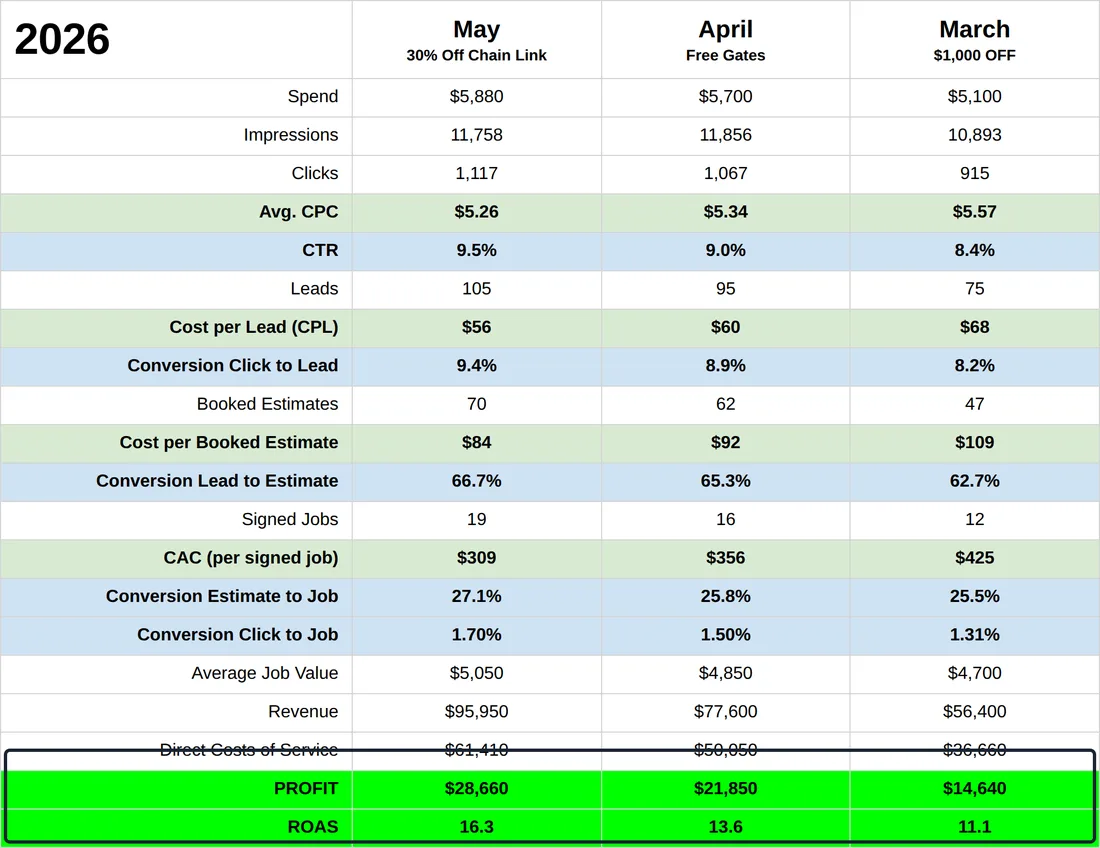
One example from home services: a fence company in North Dakota. In May 2026 a lead cost about $56, two out of three leads (67%) turned into a booked estimate, and each new customer cost $309 on an average job of about $5,000. There was no magic ad. The ads and the website showed why this company was worth choosing, every lead got a reply within minutes, every step had an owner, and no estimate was left without a next step.

I work alone — no account managers, no junior team. You always talk to me. I don’t just run ads: I build the sales side too — call scripts, follow-up messages, email templates — and I own how many leads turn into estimates and paid jobs.
When you’re ready to hand it off
Not sure which bucket you’re in? Book the free growth plan call. I’ll look at demand for your service in your area and what a lead should cost, and tell you straight whether an agency makes sense for you right now — even if the answer is “not yet.”
Done for you: work with me
A good fit if
- the business already makes steady money and you want to grow, not experiment;
- you’d rather be on jobs than learning ad platforms, websites and automations;
- you can put about $2,000 a month into marketing, ad spend included.
What I do
- Leads that turn into jobs. Your ads and website show why your company is worth the money — your work, your process, what’s included, your warranty, your reviews — so the people who reach out want results, not the lowest bid.
- Google and Meta ads — live in 3 days.
- A website or a page for your service — with a clear “book an estimate” button.
- No lead slips through — instant text and email after every lead, missed-call text-back, estimate booking, reminders after the quote.
- A sales system — call scripts, quote and email templates, rules for whoever answers the phone.
How I work
- No contracts. Pay by the week; stop any week.
- Everything is yours. Domain, website, ad accounts and customer list are in your name from day one.
- Reports in jobs: leads, booked estimates, quotes, paid jobs and what each job cost.
- You work directly with me. No account managers.
- No promised lead counts — I own the quality of the setup, the speed and honest numbers.
Who this won’t work for
- If you want a guarantee of “50 leads a month.” I don’t give one, and I’d be careful with anyone who does.
- If nobody is going to answer the phone or the texts. No ad can save a lead that gets a reply two days later.
- If you’re looking for a way to fake reviews or a quick trick instead of a system.
Questions owners ask
Why would an agency owner tell me to do it myself?
Because management fees on a small budget don’t pay off, and in two months I’d have an unhappy client and you’d have spent money for nothing. I’d rather work with you later, when the budget is there and you know your numbers.
What’s the minimum budget to work with you?
Realistically about $2,000 a month including ad spend: management starts at $220 a week per channel (about $950 a month), plus ad spend from $1,000 a month per channel and a one-time launch fee. Full pricing is on the pricing page.
Can I start with a freelancer and switch later?
Sure — just make sure the ad account, website and domain are in your name, not theirs. Then switching is a login change, not a rebuild.
How much time does DIY really take?
Plan on several hours a week, more in the first month while you set up your Google Business Profile, reply templates and a first campaign. After that, it’s keeping it running and watching the numbers.
What if I hire you and it isn’t working?
You pay by the week with no contract. Tell me by Friday, next week isn’t billed, and you get every login and file within 3 business days. No penalty.
I already got burned by an agency
That’s why there’s no annual contract, everything is in your name from day one, and the report is in booked estimates and jobs — not just a lead count.
Do you guarantee a number of leads?
No. I own the quality of the setup, the speed and honest numbers. Lead-count guarantees come from people who count leads instead of jobs.