

This article is for owners of home service companies who are paying an agency or a freelancer to run their ads right now. If every month you get a report with a lead count and a cost per lead, and you still can't say how many jobs the ads brought in, read to the end. I'll show you the five numbers every honest report should have, what each one tells you, how to track them yourself in 15 minutes a week even if your agency doesn't, and what a real report "in jobs" looks like, with actual numbers. At the end: what to do next.
In this article
- Sound familiar?
- Why cost per lead says nothing about money
- The 5 numbers every report should show
- What a report in jobs looks like
- How agencies hide behind lead counts
- Why the usual fixes don't help
- How to get these numbers even if your agency doesn't track them
- Who I am and why I do this
- Where to go from here
- Who this isn't for
- Questions owners ask
Friday evening. An email from the agency: "Great month! 112 leads, cost per lead down 22%." Green arrows, charts going up. You open your calendar: four estimates, one signed job. You call your account manager, and he calmly explains: "The leads are coming in. After that, it's on your sales process."
Maybe he's right. It happens: good leads, and the quote goes out a week late with no follow-up call. But neither of you can check, because the report doesn't have the numbers that would show where the money actually leaks. Sounds like an argument nobody can win? Let's run the numbers, and the argument ends.
Sound familiar?
📊A great-looking report and no money
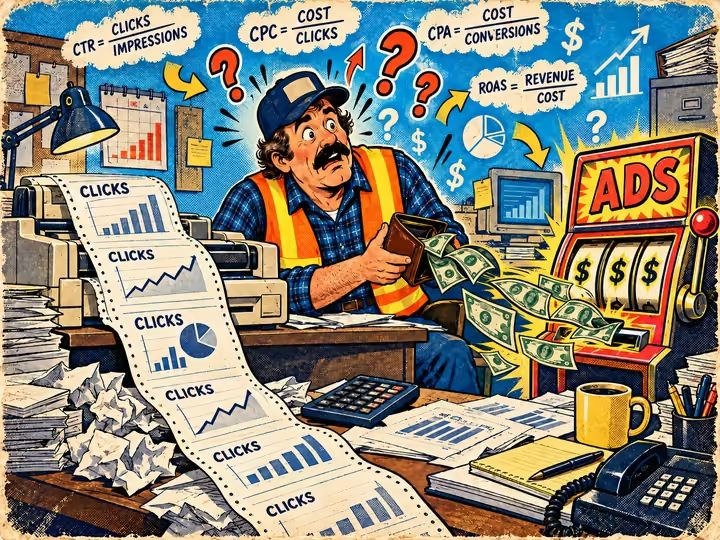
- Every month there's a twelve-page PDF. When you ask how many jobs the ads brought in, the agency says, "That part's on your end."
- Cost per lead goes down every month, and revenue doesn't move. They congratulate you on a record, and you're doing the math on whether payroll clears.
- You're not a marketer, and you don't know what to ask. Arguing with someone who throws jargon at you feels like arguing with a mechanic about the knocking in your engine.
🎣Leads that aren't really leads
- One doesn't pick up. Another lives two counties over where you don't work. The third wants to know if you're hiring. The fourth "just wanted a ballpark."
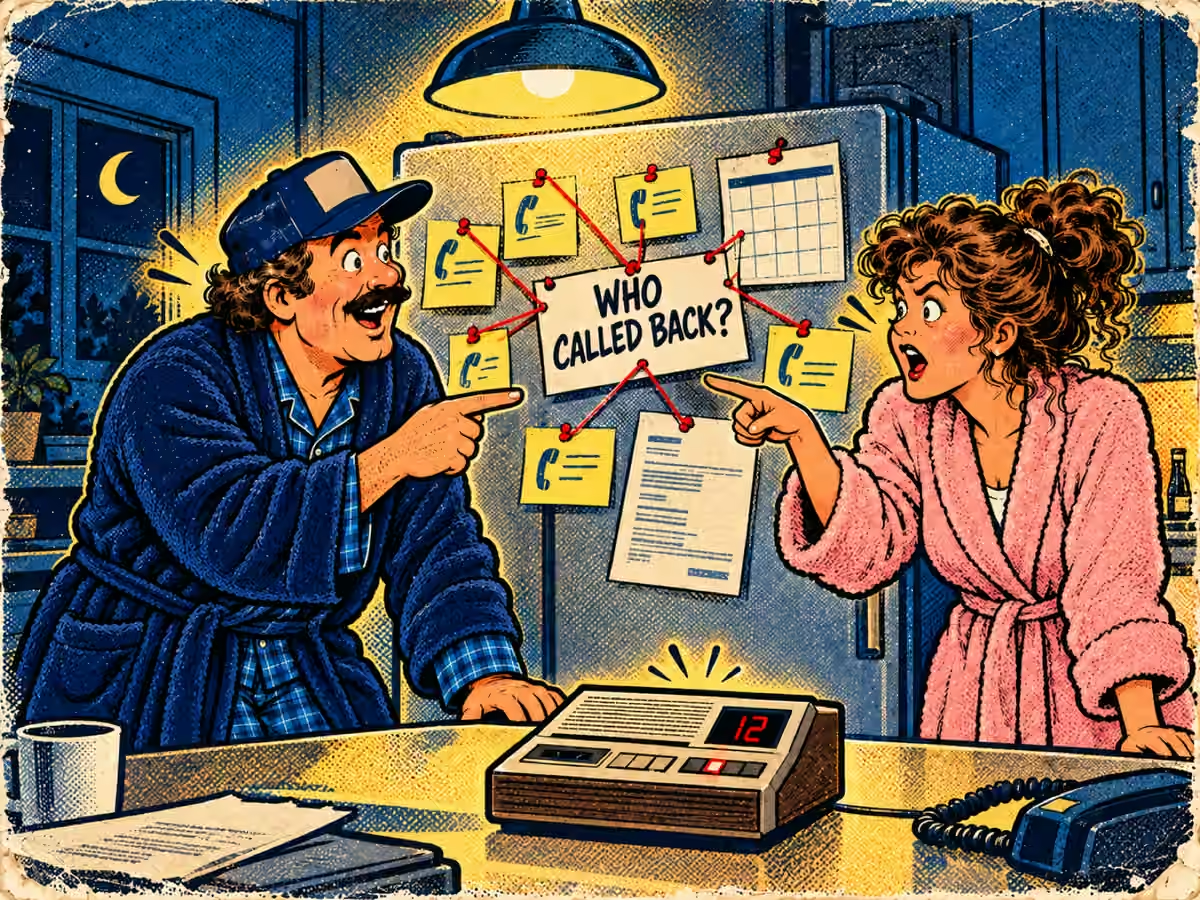
- You spend Saturday calling through a list the report calls "leads."

- The few who do book an estimate put your quote next to four others and go with the lowest one.
🔁The same conversation on repeat
- "We need more budget, the algorithm is still learning." Third month in a row.
- "The leads are fine, the problem is your sales." Maybe. But you have no way to prove otherwise, and that's what really gets under your skin.
- Your account manager changed, and the new one sends the same report with a different name at the bottom.
If this sounds like you, nothing's wrong with you. You're looking at the numbers you're shown. The problem is that the agency reports whatever is convenient to count, and what's convenient to count is whatever goes up easily.
Why cost per lead says nothing about money
A cheap lead isn't hard to get. A "free quote in 30 seconds" promise, a discount in the headline, a two-field form, an ad aimed at everybody, and everyone responds: people collecting five quotes, people 80 miles out, people looking for a job, people who tapped by accident. The report shows a record. The calendar shows nothing.
I do it the other way around. Your ads, website and Google profile explain why your company is worth the money: they show your work, your process, what's included, your warranty, your reviews. Someone shopping for the lowest number scrolls right past that ad. Someone who wants the job done right calls. You get fewer leads, and each one costs more, but they're the ones who book the estimate and sign the contract.
Paying an agency per lead is like paying a salesman per handshake. He'll shake hands with everybody in the Home Depot parking lot and close nothing, and you pay for every handshake.

The 5 numbers every report should show
All five come from three things: how much you spent on ads, what happened to each lead, and how much in signed contracts came out of it.
- Leads, and how many are real. A real lead is a live person in your service area who needs what you do. Spam, duplicates, five-second calls and job seekers go on a separate line. This number tells you one thing: are the ads bringing people in at all. Look at cost per lead, sure, but it's the first of five numbers, not the main one.
- Booked estimates. How many leads turned into an estimate or a site visit, and what share that is. This shows whether they're the right people and whether someone gets to them fast. If leads go up while the share of booked estimates goes down, the ads are bringing in the wrong people.
- Signed jobs. What share of quotes turned into a contract. This tells you whether you're getting people who value quality or bargain hunters, and how well your quote does its job.
- Cost per job. Ad spend divided by signed jobs. The most important number on the whole report. Don't compare it to the cost per lead your buddy brags about; compare it to the profit you keep on one job. Add the agency fee to the spend and you'll see the full cost.
- Revenue from jobs, and return on ad spend. The total of signed contracts, and how many dollars of revenue each ad dollar brought in (agencies call it ROAS). This answers the question the whole thing exists for: are the ads making money or eating it.

What a report in jobs looks like
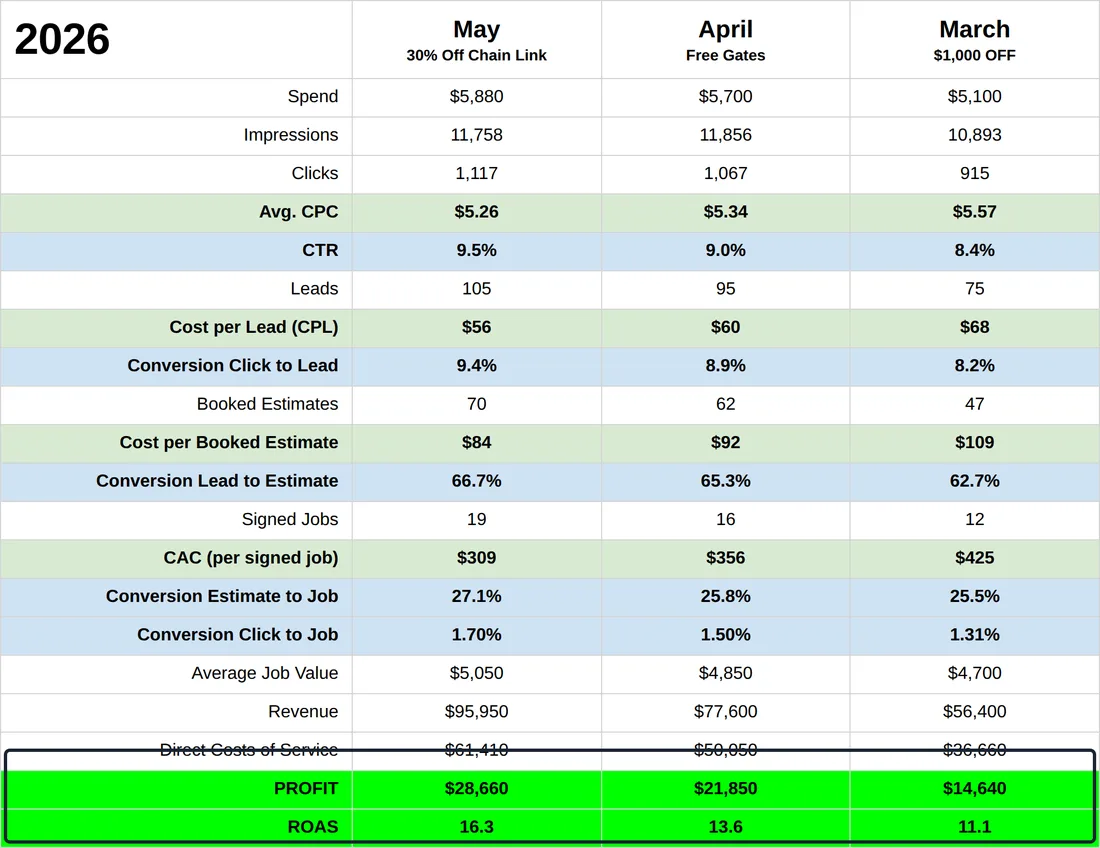
A real example: a fence company in North Dakota, a client of mine. The report for May 2026:
- Ad spend: $5,880.
- Leads: 105, at $56 on average.
- Booked estimates: 70. Two out of three leads (67%) booked one, at $84 per estimate.
- Signed jobs: 19. 27% of quotes turned into contracts, at $309 per new customer.
- Revenue: $95,950 on an average job of $5,050, about $16 in revenue for every ad dollar. Profit after direct costs: $28,660.
Look at the cost per lead. $56 isn't a record low, and I wasn't chasing one. I was chasing something else: two out of three leads booking an estimate, and a cheaper customer. From March to May, cost per lead went from $68 to $56, about 18% down. Cost per customer went from $425 to $309, about 27% down. The customer got cheaper faster than the lead did, because the leads themselves got better, and so did the way they were handled. On a report "in leads," those two months would look like a modest improvement. On a report "in jobs," you can see the thing that matters changed.
And here's the comparison the whole exercise is for: on each job the company keeps about $1,500 in profit on average ($28,660 across 19 contracts), and the ads for that job cost $309. That gap is what tells you whether to add budget, not what a lead cost.
How agencies hide behind lead counts
Most agencies aren't lying. They just count what makes them look good. Still, it pays to know the moves when you see them.
- Everything counts as a lead: spam, duplicates, the same person calling twice, calls that last a few seconds, job seekers.
- Bragging in percentages: "cost per lead down 30%," with no mention that quality dropped too and fewer estimates got booked.
- Taking credit for people who were already searching for you by name. They'd have called without the ads, but on the report they look like the ads' win.
- Every question about jobs gets pushed back to your sales: "We delivered the leads, the rest is on you."
- Asking for more budget without ever showing what a job cost at the current one.
For reference: in 2026 the average lead from search ads in the home and home improvement category costs about $91 (LocaliQ data). Leads that are much cheaper aren't automatically bad. But it's a good reason to ask how many of those people booked an estimate.
Why the usual fixes don't help
"I'll ask for cheaper leads"
You'll get them. The agency will open up the targeting, put a discount in the ad, shorten the form, and the leads will get cheaper and worse. You asked for the one number that isn't tied to money, and they honestly improved it.
"I'll raise the budget and get more jobs"
If you don't know your cost per job, you're scaling a mystery. A bigger budget amplifies whatever is already there: good ads bring more jobs, bad ads bring more dead-end calls.
"I'll switch agencies"
A new agency with the same report is the same story three months later, with a new account manager and a new setup fee. Before you change the agency, change the numbers you judge it by.
"I'll just look at the ad account myself"
The ad account knows how many leads came in. It has no idea who signed a contract; only you know that. Without your estimate and contract data, nobody can calculate cost per job: not Google, not the agency, not me.
How to get these numbers even if your agency doesn't track them
You don't need expensive software for this. You need a spreadsheet and 15 minutes a week.
- A spreadsheet or CRM stages. Columns: date, name, lead source, real lead (yes/no), estimate date, quote amount, signed (yes/no), contract amount, reason for a no. In a CRM, the same stages: new lead → contacted → estimate booked → quote sent → signed or lost.
- A source for every lead. Ask "How did you hear about us?" and write it down. For ads, use a separate phone number or a separate form so you're not guessing.
- 15 minutes every Friday. Update the statuses and you're done. One person owns it, not "everybody chips in."
- Once a month, five divisions. The formulas are below.
- Send the spreadsheet to your agency and ask them to report the same way. A good agency will be glad: with this data they can optimize the ads for jobs, not leads. A bad one will start explaining why it can't be done.
Run last month's numbers
- Cost per lead = ad spend ÷ real leads.
- Booking rate = booked estimates ÷ real leads.
- Close rate = signed jobs ÷ estimates.
- Cost per job = ad spend ÷ signed jobs.
- Return on ad spend = revenue from signed contracts ÷ ad spend.
Now compare cost per job to the profit you keep on one job. If there's plenty of room, it's worth talking about budget. If cost per job eats almost all the profit, budget isn't the problem: find the step where the rate drops. Booking rate falling means the ads bring the wrong people or you're slow to respond. Close rate falling means you're getting bargain hunters, or your quote doesn't explain what they're paying for.
If your contracts get signed two or three months after the lead comes in, tie each contract to the month the lead arrived and judge the ads with that lag. Cost per job just shows up later, but it shows up.
Five questions for your agency this week
- How many jobs did the ads bring in last month?
- What did one job cost?
- How many leads do you not count as real, and why?
- Which ads bring in people who sign, and which only bring in cheap leads?
- What do you need from me to track jobs?
A good answer to the last one is "your estimate and contract data, once a week." A bad one is "that's not our department." My clients get exactly this kind of report every week: leads, estimates, quotes, jobs and cost per job.
Who I am and why I do this

I’m Eddie A. For 12+ years I’ve worked in marketing and sales: projects in 50+ industries, ad budgets up to $60,000 a month, and $12M+ in revenue attributed to campaigns I managed — in the U.S., Canada, the UAE, Turkey, Europe and Kazakhstan. I’m based in Apopka, Florida, and run a registered LLC.
- 12+years in marketing and sales
- 50+industries I’ve run ads for
- $60Kmax monthly ad budget
- $12M+revenue from my campaigns
One example from home services: a fence company in North Dakota. In May 2026 a lead cost about $56, two out of three leads (67%) turned into a booked estimate, and each new customer cost $309 on an average job of about $5,000. There was no magic ad. The ads and the website showed why this company was worth choosing, every lead got a reply within minutes, every step had an owner, and no estimate was left without a next step.

I work alone — no account managers, no junior team. You always talk to me. I don’t just run ads: I build the sales side too — call scripts, follow-up messages, email templates — and I own how many leads turn into estimates and paid jobs.
Where to go from here

Done for you: work with me
A good fit if
- the business already makes steady money and you want to grow, not experiment;
- you’d rather be on jobs than learning ad platforms, websites and automations;
- you can put about $2,000 a month into marketing, ad spend included.
What I do
- Leads that turn into jobs. Your ads and website show why your company is worth the money — your work, your process, what’s included, your warranty, your reviews — so the people who reach out want results, not the lowest bid.
- Google and Meta ads — live in 3 days.
- A website or a page for your service — with a clear “book an estimate” button.
- No lead slips through — instant text and email after every lead, missed-call text-back, estimate booking, reminders after the quote.
- A sales system — call scripts, quote and email templates, rules for whoever answers the phone.
How I work
- No contracts. Pay by the week; stop any week.
- Everything is yours. Domain, website, ad accounts and customer list are in your name from day one.
- Reports in jobs: leads, booked estimates, quotes, paid jobs and what each job cost.
- You work directly with me. No account managers.
- No promised lead counts — I own the quality of the setup, the speed and honest numbers.
Who this isn't for
- If you want "50 leads a month" at any cost. I don't guarantee lead counts, and I'd advise you not to trust anyone who does.
- If you're not willing to mark what happened to each lead. Without your contract data, nobody can calculate cost per job, me included.
- If your total marketing budget is under about $2,000 a month. Management starts at $220 a week, plus at least $1,000 a month in ad spend per channel, so the math gets tight. Start with the spreadsheet from this article and come back when you're ready to scale.
Questions owners ask
My agency says sales isn't their job
They don't have to sell for you. But they do need to know which ads bring in people who sign, or they're optimizing blind. All it takes is your estimate and contract data once a week.
I don't have a CRM
A nine-column spreadsheet is plenty to start. A CRM is easier: stages, reminders, and the lead source gets recorded automatically. In my system the report in jobs builds itself from those stages.
My sales cycle is long. Contracts get signed 2–3 months after the lead
Tie each contract to the month the lead came in and judge the ads with that lag. Cost per job shows up later, but it shows up. Just don't judge the ads by cost per lead while the contracts are still in the pipeline.
I don't have time to keep a spreadsheet
It's 15 minutes a week. You already spend more than that calling leads you never should have paid for. Without it, you keep paying for ads without knowing whether they pay off.
Do you guarantee a cost per job?
No, and I don't guarantee lead counts either. What I do guarantee: you see your cost per job every week, you work directly with me, and you can stop any week. Tell me before Friday and the next week isn't billed.
What does it cost to work with you?
Google Ads management starts at $220 a week, plus a setup fee and an ad budget of at least $1,000 a month per channel that you pay directly. Everything is in your name, no 12-month contract. Full pricing is on the pricing page.
What if my agency already reports all five?
Then you have a good agency, and this article just confirmed it. Keep them. If you ever want a second opinion on the numbers, the growth plan call is free.