

This article is for home service owners whose phones ring in the evening, at night and on weekends: HVAC, plumbing, roofing, remodeling, electrical, fencing, anyone homeowners get around to calling after their own workday. No hype here. I'll walk through what an AI receptionist that answers your calls can do, and what it can't and shouldn't do. You'll get an honest list of limits, the legal fine print, what it costs and a quick way to figure out what after-hours calls are costing you right now. At the end, a clear next step: set it up with me or start with a free growth plan call.
In this article
11 PM. Somewhere in your town a homeowner has finally gotten the kids to bed, sat down on the couch and opened Google. Mornings are a blur of work, school drop-off and traffic. Tonight is the first chance she's had to deal with the stain on the ceiling that's been growing since last weekend. She calls the first company: voicemail. The second: "the mailbox is full." At the third, someone picks up. A calm voice asks for the address, what happened, when works for her, and books her for Thursday at 9 AM. A minute later a text confirmation lands on her phone.
Guess who gets the job. Doesn't matter that the first company does the best roofs in the county.
Odds are, the one who answered at the third company that night wasn't a person. Sounds like another shiny gadget somebody's trying to sell you? You're partly right. That's why this article spends as much time on what an AI receptionist can't do as on what it can.
Sound familiar?
🌙Evenings and weekends
- A call comes in at 9:40 PM, you're at dinner with the family. You decide to call back in the morning. In the morning the homeowner politely tells you they already booked someone.
- Saturday, you're on a job and the phone's in the truck. That evening: four missed calls from unknown numbers. You call back. Two don't answer, one already hired someone, the fourth is spam.
- Hardly anyone leaves a voicemail. A missed call with no message is just someone who dialed the next name on the list.

📞You're your own dispatcher
- You take calls from a roof, from under a sink, from behind the wheel. The customer's address is written in Sharpie on a box of screws, and the box just left with the crew.
- When you're tied up, your wife answers. But she doesn't know what to ask or when you've got an opening for an estimate, so it's "he'll call you back."
- That call came from an ad you paid for. Miss it, and your ad money just went to work for a competitor.
😮💨The part that wears on you
- The phone stays on the nightstand. What if it's a job? You can't switch off, not on vacation, not on Sunday.
- Every missed call feels like cash falling out of your pocket. You catch yourself checking your phone while your kid is talking to you.
- And the frustration: you got into this to build fences or fix AC units, not to run a call center with no days off.
What happens to after-hours calls today
"Voicemail's got it covered"
Makes sense: they leave a message, I call back in the morning. But someone with water coming through the ceiling isn't planning to wait until morning to find out whether anyone's coming. They call the next company. And in the morning you see a bare number in your call log. No name, no address, no clue whether it was an $8,000 job or a robot selling an extended car warranty.
"I'll just always pick up myself"
Works until busy season. Then you're answering on the fly, at 11 PM you're too tired to write down the address, you mix up days, you promise to call back and don't. The hidden cost is sleep, family and the fact that your most important conversations get whatever energy you have left at the end of the day.
"I'll hire a live answering service"
A solid option if the operators actually book customers into your calendar and know what to ask. But plenty of services just take a message and pass it along in the morning. That's voicemail with a nicer voice. To get an operator to qualify a call and book an estimate, somebody has to train them, and operators change from shift to shift. And you're paying for every minute of their time.
"I'll put in AI and let the office manager go"
Don't. An AI receptionist takes the night shift and the first conversation. Selling, calming down an upset customer, talking price and getting a quote to a decision are still a person's job. Anyone promising a robot will replace your sales team is selling you a fairy tale, not a system.
What an AI receptionist does
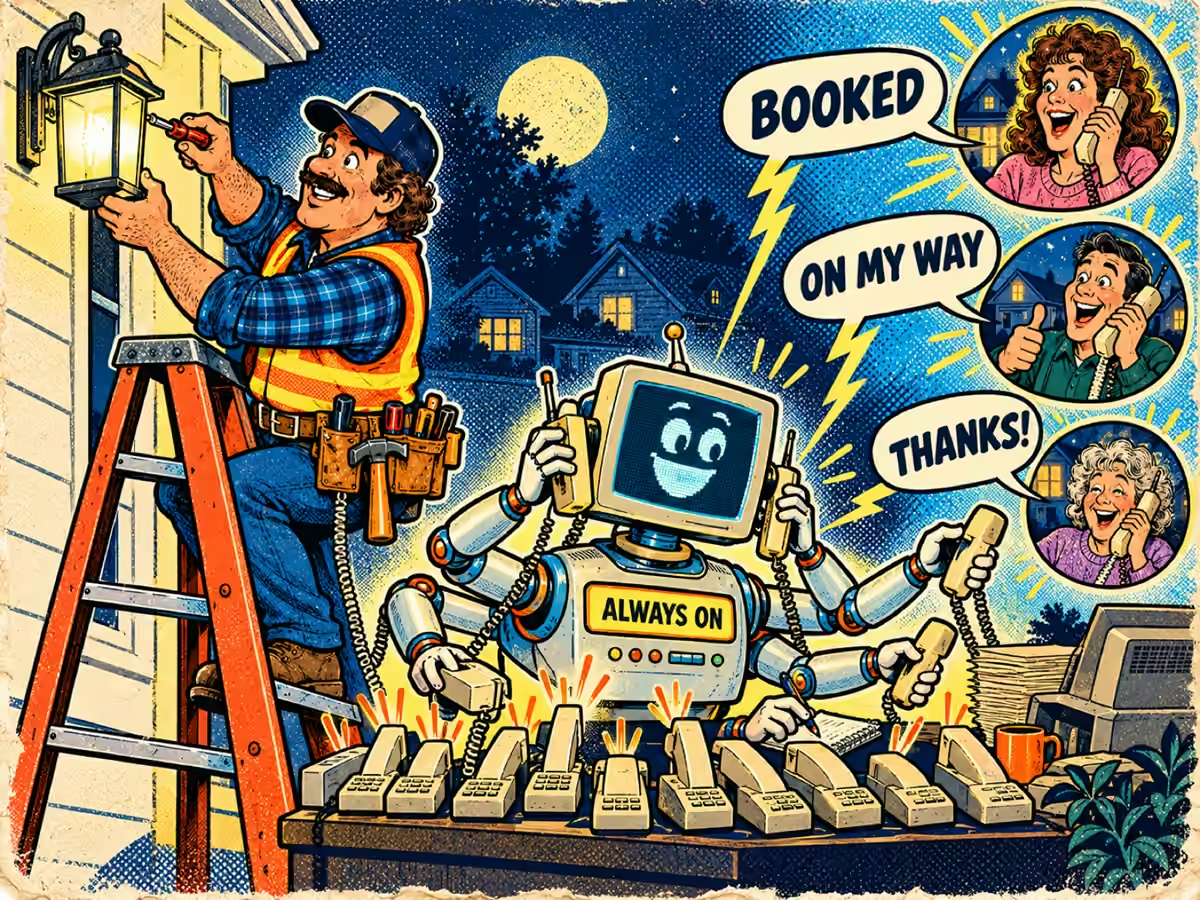
In plain terms: it's a voice assistant on your business number. It answers when you can't: at night, on weekends, or when you don't pick up. It sounds like a calm front-desk person, not a "press 1 for service" menu. Here's what happens on the call:
- Answers right away — 24/7, holidays included, and Saturdays in peak season.
- Asks the right questions — what's going on, which service, the address (is it in your area), how urgent, the customer's name and the best way to reach them. We write the questions together for your trade: a plumber needs different answers than a roofer.
- Handles the common questions — do you work in this area, is there a warranty, how long does an estimate take. Only what you've given it. No making things up.
- Books the estimate — into an open slot on your calendar, not "we'll call you back."
- Sends a text — a confirmation with the date, time and address.
- Leaves it all in your CRM — a customer record with the answers and the call recording. In the morning you open a list of booked estimates, not a list of missed calls.
What it doesn't do, honestly
- It doesn't transfer calls to a live person. If the caller says "put me through to the owner," the assistant takes a message and you call back yourself. A call you absolutely can't miss won't get "handed off" to you at 11 PM. That's not how it works.
- It doesn't negotiate or give a final price. If you want, it can give a "starting at" number and explain the exact price comes after the estimate. Discounts and "what if we skip the haul-away?" aren't its department.
- It's not a salesperson. It doesn't persuade, doesn't handle "the other guy is cheaper," doesn't close. Its job is to get the person to a booked estimate. From there it's you.
- It doesn't fix emergencies. If a pipe bursts, it'll take the details and flag it, but it can't drive over. What it says on urgent calls is something we decide up front.
- It can get things wrong. Background noise, a bad connection, a tricky last name, a house number: it'll ask again, but sometimes it'll still write it down wrong. That's why every booking gets a confirmation text where the customer sees the address and time for themselves.
- Some people will hang up once they realize they're talking to an assistant. That's fine. Their other option was voicemail, and they weren't talking to that either.

And two legal points the people selling these tools rarely bring up. First, the call gets recorded. In some states, including Florida and California, recording a phone call requires the consent of everyone on it (state-by-state overview). So the recording notice belongs at the start of the call, out in the open. Second, the assistant only answers incoming calls. Calling people with an AI voice is a different story: in 2024 the FCC ruled that AI-generated voices count as "artificial" under the Telephone Consumer Protection Act (TCPA), and those calls need the person's prior consent.
How it works with your follow-up
An AI receptionist is one link, not the whole chain. Think of a hotel. The night clerk checked the guest in, great. But if nobody remembers the 7 AM wake-up call, the guest misses the flight and blames the hotel. Estimates work the same way: booking someone isn't enough. They need to be home when you show up, and then get a quote that doesn't disappear into silence.
So the assistant is plugged into the follow-up system:
- Reminders before the estimate — the day before and an hour before. Fewer locked doors and "oh, I forgot."
- A text to anyone who didn't book — if the caller hung up halfway, they get a text with a link to pick a time themselves.
- Missed-call text-back during the day — when the assistant is off and you're on a job, the customer still hears back within seconds.
- Follow-up after the quote — so the quote doesn't just hang there, and you get a yes or an honest no.
- One customer record — every call, text and booking in one place. Nobody has to ask "wait, who called this guy back?"
There's a flip side. The assistant answers great, but it doesn't choose who calls you. If your ads attract people shopping for the lowest number, it'll dutifully book them too. That's why your ads and website have to show why your work is worth the money first: the process, what's included, the warranty, the reviews. Then the people calling want the job done right, and the AI receptionist makes sure none of those calls ends up with a competitor.

Where you still need a person
The estimate on site. The price conversation. Answering "let me think about it" and "the other guy is cheaper." A complicated job where you need to see it before you promise anything. An upset customer who needs the owner, not a script. And calling back the person who asked to speak with you. That's all human work, and no assistant is taking it away.
My take is simple: AI handles the night shift and the first call, so your voice and your energy go to what actually makes money, estimates and quotes. In the morning you've got a calendar with booked customers instead of a list of missed calls.
What it costs
I set up follow-up in tiers. Missed-call text-back is $25 a week. Lead tracking plus automatic replies is $69 a week. The full version with the AI receptionist costs more; the exact number is on the pricing page. Plus a one-time setup: $450, $1,200 or $1,500 depending on the tier.
Call minutes and texts are billed at cost, no markup: whatever the phone carrier charges is what you pay. You pay by the week, no contract. Want to stop? Tell me by Friday and you don't pay for the next week. All your logins and files come back to you within 3 business days, no penalty. Your customer list is in your name from day one.
Count your after-hours calls
Five minutes with your call log
Pull up the last 30 days of your call log and answer:
- How many calls came in between 6 PM and 8 AM, and on weekends?
- How many of those did you miss?
- How many did you call back within an hour?
- Of the ones you called back, how many booked an estimate?
- What's your average job, and what share of your quotes turn into signed contracts?
Now the math. Hypothetical example: 20 missed after-hours calls from real customers in a month. If even a quarter of them would have booked an estimate with a fast answer, that's 5 estimates. If one in four quotes gets signed (the fence company in the case below closed 27%), that's 1 or 2 jobs. On an average job of around $5,000, that's $5,000–10,000 a month going to whoever picked up. Plug in your own numbers. If you get two after-hours calls a month, you don't need an AI receptionist yet. If you get twenty, do the math.
Who I am and why I do this

I’m Eddie A. For 12+ years I’ve worked in marketing and sales: projects in 50+ industries, ad budgets up to $60,000 a month, and $12M+ in revenue attributed to campaigns I managed — in the U.S., Canada, the UAE, Turkey, Europe and Kazakhstan. I’m based in Apopka, Florida, and run a registered LLC.
- 12+years in marketing and sales
- 50+industries I’ve run ads for
- $60Kmax monthly ad budget
- $12M+revenue from my campaigns
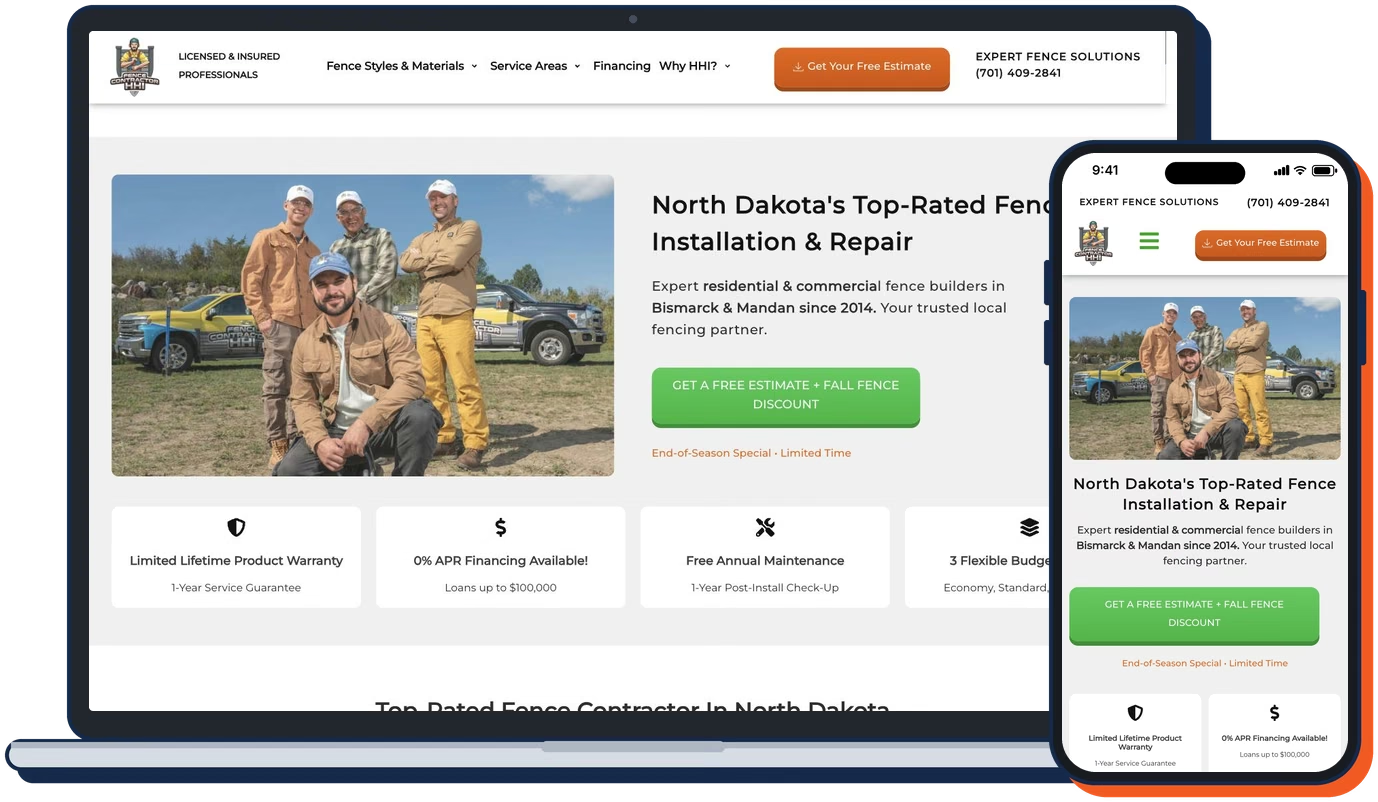
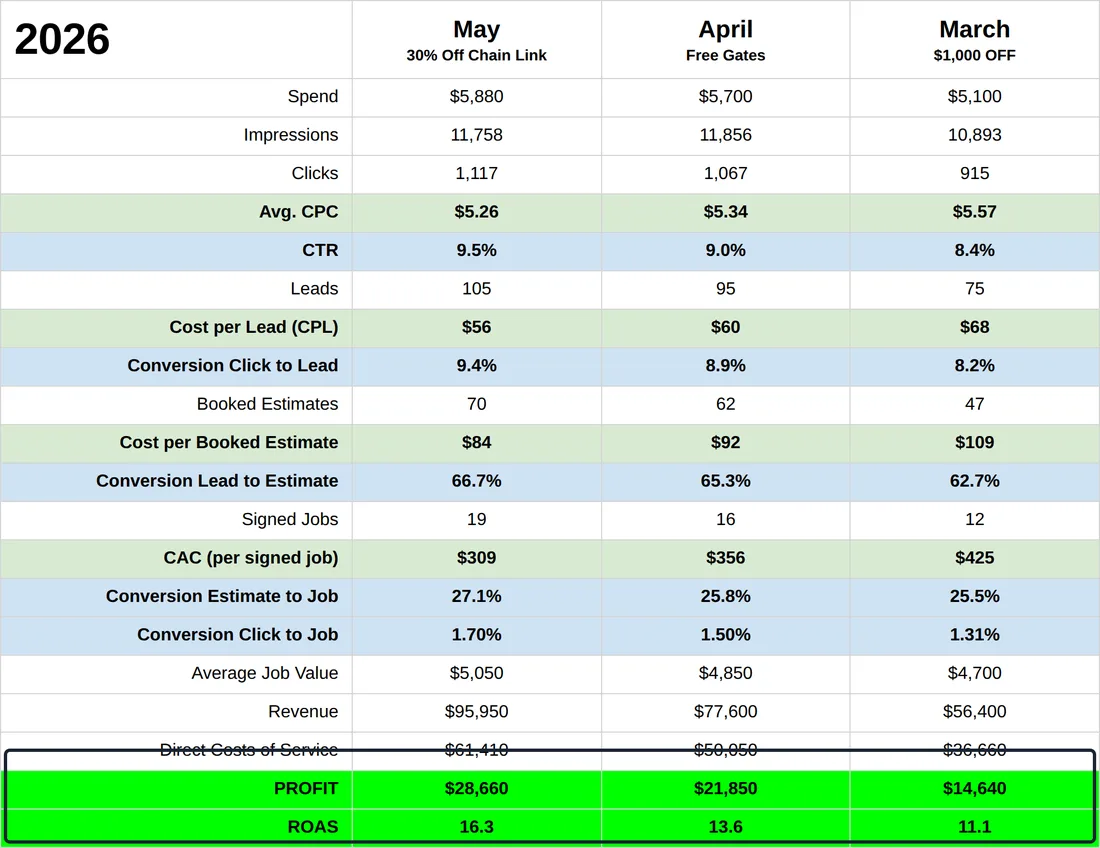
One example from home services: a fence company in North Dakota. In May 2026 a lead cost about $56, two out of three leads (67%) turned into a booked estimate, and each new customer cost $309 on an average job of about $5,000. There was no magic ad. The ads and the website showed why this company was worth choosing, every lead got a reply within minutes, every step had an owner, and no estimate was left without a next step.
I work alone — no account managers, no junior team. You always talk to me. I don’t just run ads: I build the sales side too — call scripts, follow-up messages, email templates — and I own how many leads turn into estimates and paid jobs.
Where to go from here

Done for you: work with me
A good fit if
- the business already makes steady money and you want to grow, not experiment;
- you’d rather be on jobs than learning ad platforms, websites and automations;
- you can put about $2,000 a month into marketing, ad spend included.
What I do
- Leads that turn into jobs. Your ads and website show why your company is worth the money — your work, your process, what’s included, your warranty, your reviews — so the people who reach out want results, not the lowest bid.
- Google and Meta ads — live in 3 days.
- A website or a page for your service — with a clear “book an estimate” button.
- No lead slips through — instant text and email after every lead, missed-call text-back, estimate booking, reminders after the quote.
- A sales system — call scripts, quote and email templates, rules for whoever answers the phone.
How I work
- No contracts. Pay by the week; stop any week.
- Everything is yours. Domain, website, ad accounts and customer list are in your name from day one.
- Reports in jobs: leads, booked estimates, quotes, paid jobs and what each job cost.
- You work directly with me. No account managers.
- No promised lead counts — I own the quality of the setup, the speed and honest numbers.
Who this isn't for
- If you hardly get calls after hours. Start with missed-call text-back at $25 a week. That may be all you need.
- If you want AI to do your selling. It books the estimate. You make the sale.
- If every night call has to reach a live human, like a 24/7 emergency service. Then you need someone on call or an answering service that transfers calls.
- If you want a guarantee of "X jobs a month." I don't give one, and I'd advise you not to trust anyone who does.
Questions owners ask
Won't customers get annoyed talking to a robot?
Some will hang up, and that's the honest answer. But at 11 PM the alternative isn't you, it's voicemail. Most people care more about getting booked and getting a confirmation than about who did the booking.
Will it put the call through to me if the customer insists?
No. The AI receptionist doesn't transfer calls to a live person. It takes a message, saves it in the customer record, and you call back yourself. If you need night calls transferred, you need someone on call or an answering service.
What if it books the wrong time?
It only books into slots you've opened on your calendar. The customer gets a text with the date, time and address and can spot anything that's off. You see every booking in your CRM and can move any of them.
Can I run it only on nights and weekends?
Yes, that's how most owners start: you or your office answer during the day, the assistant takes evenings and weekends. If you miss a call during the day, the customer still gets a missed-call text-back.
What do minutes and texts cost?
Exactly what the phone carrier charges: at cost, with no markup from me. Management is billed weekly with no contract, and setup is $450, $1,200 or $1,500 depending on the tier.
Will it sound like a phone menu?
No. It talks like a calm receptionist, asks questions in plain English and answers only with the information you've given it. We write the questions and answers together for your trade.
Who sets it up and who do I talk to?
I do, personally. No account managers, no handoff to a junior a month in. You work directly with me.