
This one is for family-run home service companies — one of you is on the job, and the phone, the quotes and the invoices are run by a spouse, a parent or a grown kid. If your office is the kitchen table and your system is a notebook, a group text and somebody’s memory, keep reading. You’ll see exactly where family businesses lose leads, how to check it in one evening without a fight, and how to make whoever picks up the phone sound like a real front office. At the end: do it yourselves, or have me set it up.
In this article
- Sound familiar?
- Where the chain breaks
- What families usually try — and why it doesn’t stick
- What works: one home and one owner for every lead
- How it fits together
- The one-evening check — no fighting allowed
- Who I am and why I do this
- Your next step: get the leads off the fridge
- What changes
- Who this isn’t for
- Questions owners ask
A lot of home service companies run on one person with a phone. He’s on the roof; she’s on everything else. She answers between school pickup and the grocery store, writes the address on the back of a Home Depot receipt, fields “how much does it cost?” and texts him: “Call back the lady with the fence.” He reads it at 6 p.m. Which lady? Which fence? The number is on the receipt. The receipt is somewhere in the truck.
I’m saying “she” because that’s the most common setup. In your house it might be a husband, a mom or a son — the mechanics are the same. And let me say this up front: this isn’t about anyone doing a bad job. Whoever runs the office in between kids, dinner and their own work is pulling off something heroic. The problem is that heroics don’t scale. Let me show you exactly where they crack.
Sound familiar?
📞The phone lives with your spouse
- Calls get answered in the car, at the stove, in the bleachers at practice. Details go on a hand, a napkin, a notes app — wherever there’s room.
- The caller asks, “How much?” She doesn’t have a number, says “my husband will call you back,” and can hear the interest drain out of the conversation.
- She’d rather not guess at technical questions on the spot — so half the calls end with “he’ll call you,” and “he” is on a ladder until dark.
🔁“I thought you called them back”
- A lead came to her, she forwarded it to him, he said “got it,” and both of you assumed the other one was on it. A week later it turns out nobody was.
- Or the opposite: you both call the same customer on the same day, and they have no idea who they’re supposed to be talking to.
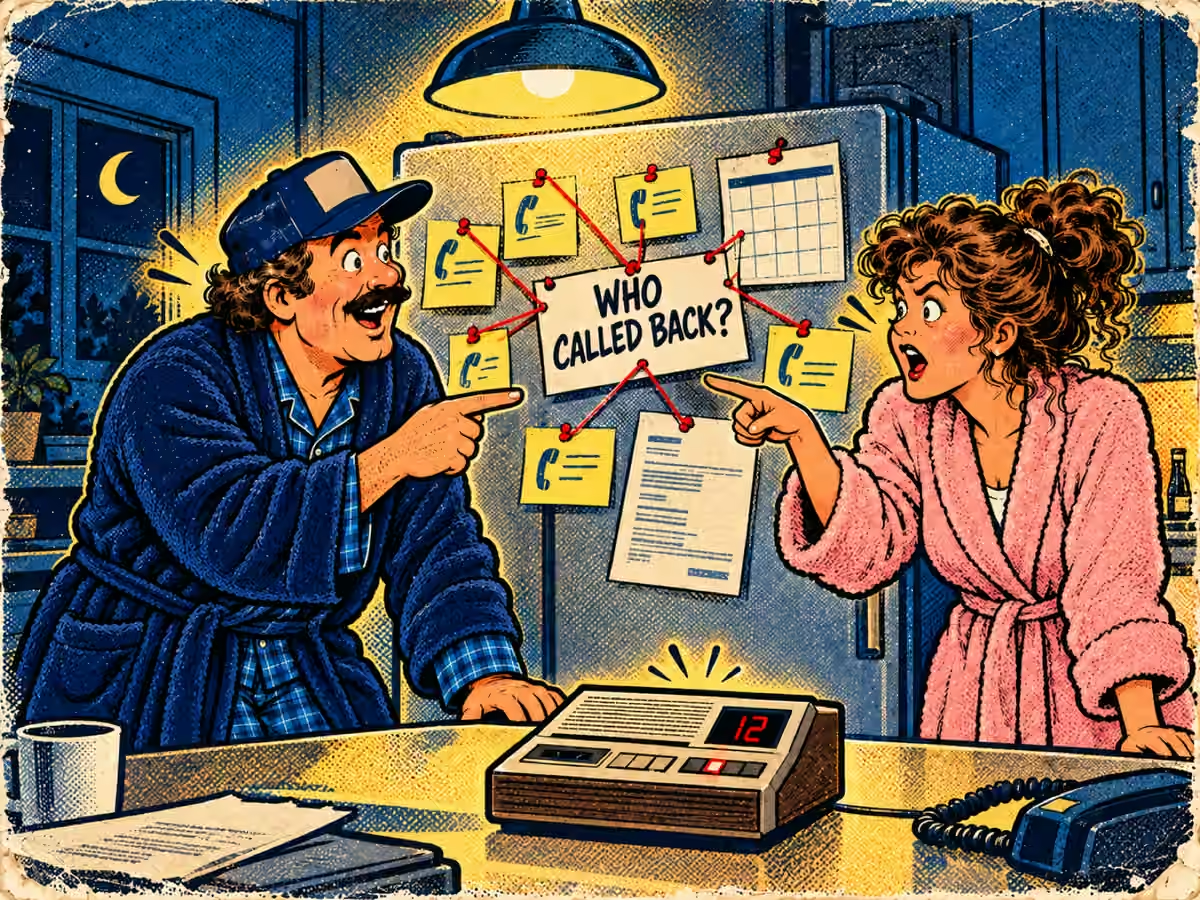
- There’s no single list of leads. There are two phones, three messaging apps, an inbox, a notebook and a pile of sticky notes on the fridge. Ask how many leads came in last month and you’ll get two different numbers.
🍽️The kitchen table after 9 p.m.
- Kids are asleep — the office opens. Quotes, invoices, callbacks, “did you ever text that guy?” The workday ends when the energy does.
- Dinner conversation about the business quietly turns into who dropped which ball. You’re both tired, you’re both right, and the customer is gone anyway.
- Vacation? The phone comes too. Turn it off for a week and, as far as customers can tell, the business stops existing.

📄The quote went out — and then nothing
- The quote is sent, the customer goes quiet. Who follows up? He’s slammed, she feels pushy, and “they said they’d think about it.”
- A month later you drive past their house and another company is putting in the fence. The one that simply texted them on day three.
If you smiled at two or more of those, you’re in good company — this is how plenty of family businesses run. It doesn’t make you bad partners or bad spouses. The business grew; the way it runs didn’t. It’s still set up like year one, when there were three calls a week and everything fit in your heads.
Where the chain breaks
Picture a relay race where nobody hands off the baton — they leave it on a bench. “I put it there, you grab it.” Sometimes somebody does. Sometimes it sits there until dark. Sometimes you both grab it and run in opposite directions. That’s roughly how a lead travels through a family business: call to her, message to him, quote back to her, follow-up to nobody.
Every handoff can break three ways. The details don’t make it: you wrote the number but not what they needed. The details make it, but nobody realizes it’s their move. Or both of you are sure it’s the other one’s move. In an office with a dispatcher, the system and the boss catch that. At the kitchen table, only memory catches it — and memory clocks out after ten hours on a job site.
There’s a second, quieter leak. Whoever answers sounds different depending on the day. Monday she cheerfully explains why your fences last twenty years. Thursday, with a toddler on her hip, it’s “uh, around forty a foot, he’ll figure it out” — and all the customer hears is the price. They compare it with the next company’s number and go cheaper, because nobody told them what they’d be paying for.
What families usually try — and why it doesn’t stick
“We’ll just pay more attention”
The most honest fix there is, and it works for about two weeks. Then busy season hits, a kid gets sick, the truck breaks down — and attention goes wherever the fire is biggest. A system that runs on effort collapses when the effort runs out. And it always runs out in the busiest month, when there are the most leads to lose.
“Let’s keep a shared notebook or spreadsheet”
A step in the right direction: at least it’s one list. But a spreadsheet doesn’t text the customer in the first minute, doesn’t remind you it’s time to ask about the quote, and gets filled in at night “from memory” — meaning it doesn’t. A month in, half the leads are in it and the other half are still on sticky notes. A spreadsheet is good at storing things. To stop losing them, you need something that nudges you to the next step on its own.
“Let’s hire someone to answer the phone”
Makes sense once the phone is ringing nonstop. But a full-time person gets paid every month, including the slow season when the phone barely rings. And a new hire writes things on napkins too if there’s no system around them — except now it’s someone you have to train and keep an eye on. Usually the spouse ends up managing the new hire and gets even more tired.
“We’ll buy a CRM and it’ll sort itself out”
Software without rules is an expensive box for sticky notes. You sign up, enter everything for a week, then drift back to the notebook because nobody knows who clicks what, or why. Order doesn’t come from buttons. It comes from agreeing where a lead lives, who owns it, and what happens automatically.
“We’re losing leads, so we need more leads”
Plenty of agencies will happily sell you that: more ads, more cheap leads, a great-looking report. But a cheap lead is usually someone who asked five companies for a price and will take the lowest. In a kitchen-table office that’s already maxed out, more of those calls just means more work for your spouse and more “he’ll call you back” into the void. First, stop losing the people who already called. Then go after people who want the job done right, not the lowest bid.
What works: one home and one owner for every lead
Every decent restaurant has a ticket rail over the line. An order comes in, the ticket goes up. Until the plate goes out, the ticket stays there, and everyone can see it’s open. Nobody keeps orders in their head, nobody asks, “Is anyone making the soup for table three?” Cooks change, servers go on break — the ticket is still hanging.
A family business needs the same thing. One place where every lead lands — calls, texts, website forms, ad messages. Every lead has an owner’s name and a next step with a date. And whatever doesn’t need a human happens automatically: the customer gets a reply in the first minute, a reminder before the estimate, a follow-up after the quote. She doesn’t have to remember. He doesn’t have to guess. You both open the same screen and see the same thing.
And to make anyone at the phone sound like a real office, you need simple scripts: how to introduce yourself, what to ask, how to book the estimate and — most important — how to answer “how much?” so the customer hears more than a number. What’s included, the warranty, the materials, how many neighbors have left reviews. Then customers compare companies, not prices. And they pick the one that explained why it’s worth the money.

How it fits together
- Every lead in one app. Calls, texts, forms, Facebook and Instagram messages land in one list you can both see. No more sticky notes, napkins or “I forwarded it to you.”
- Every lead has an owner and a next step. Not “we” — a person: “Her: book the estimate by Wednesday.” “Him: quote out by Friday.” When a deadline slips, it’s visible right away.
- The first minute is automatic. Customers get a text from your company right after they reach out and after any missed call. While she’s on school pickup, the customer already knows they were heard.
- When nobody can pick up. Add an AI receptionist: it answers 24/7 and books estimates into your calendar. It doesn’t transfer calls to a person — and it doesn’t need to. Your evening stays yours.
- Scripts for whoever answers. Short, built around your service: greeting, questions, booking the estimate, answering “how much?” with what the customer actually gets. Anyone in the family picks up and sounds confident.
- Follow-up after the quote. The system texts the customer a couple of days later and again after that — politely, no pressure. Nobody has to push through the awkwardness.
- 15 minutes a week instead of arguments at dinner. One quick check of one screen: how many came in, how many booked, how many quotes are waiting. Nothing to argue about — it’s all right there.
None of these steps asks anyone to pay more attention or work harder. The opposite: some of the work she was doing at night, the system does, and the rest stops getting lost.
The one-evening check — no fighting allowed

Sit down together for 20 minutes
One rule: you’re looking for holes, not for someone to blame. Pull the last 10 new-customer inquiries — from both phones, every messaging app and email — and answer:
- Can you both quickly name the same number: how many leads came in last month?
- For each of the 10: who replied first, and how long did it take?
- Who owns the next step on each one right now — and do they know it?
- How many quotes went out, and how many have had no reply for over a week?
- What does a customer hear when they ask her “how much?” — and when they ask him? Is it the same?
- What happens to someone who calls at 8 p.m. on a Friday?
If you named two different numbers on question one, there’s no single list. If question three gets “probably me” or “I thought you had it,” your leads have no owner. If the answers to question five don’t match, customers are hearing two different companies. Every one of those spots is money leaking out quietly — no drama, no trace.
Who I am and why I do this

I’m Eddie A. For 12+ years I’ve worked in marketing and sales: projects in 50+ industries, ad budgets up to $60,000 a month, and $12M+ in revenue attributed to campaigns I managed — in the U.S., Canada, the UAE, Turkey, Europe and Kazakhstan. I’m based in Apopka, Florida, and run a registered LLC.
- 12+years in marketing and sales
- 50+industries I’ve run ads for
- $60Kmax monthly ad budget
- $12M+revenue from my campaigns
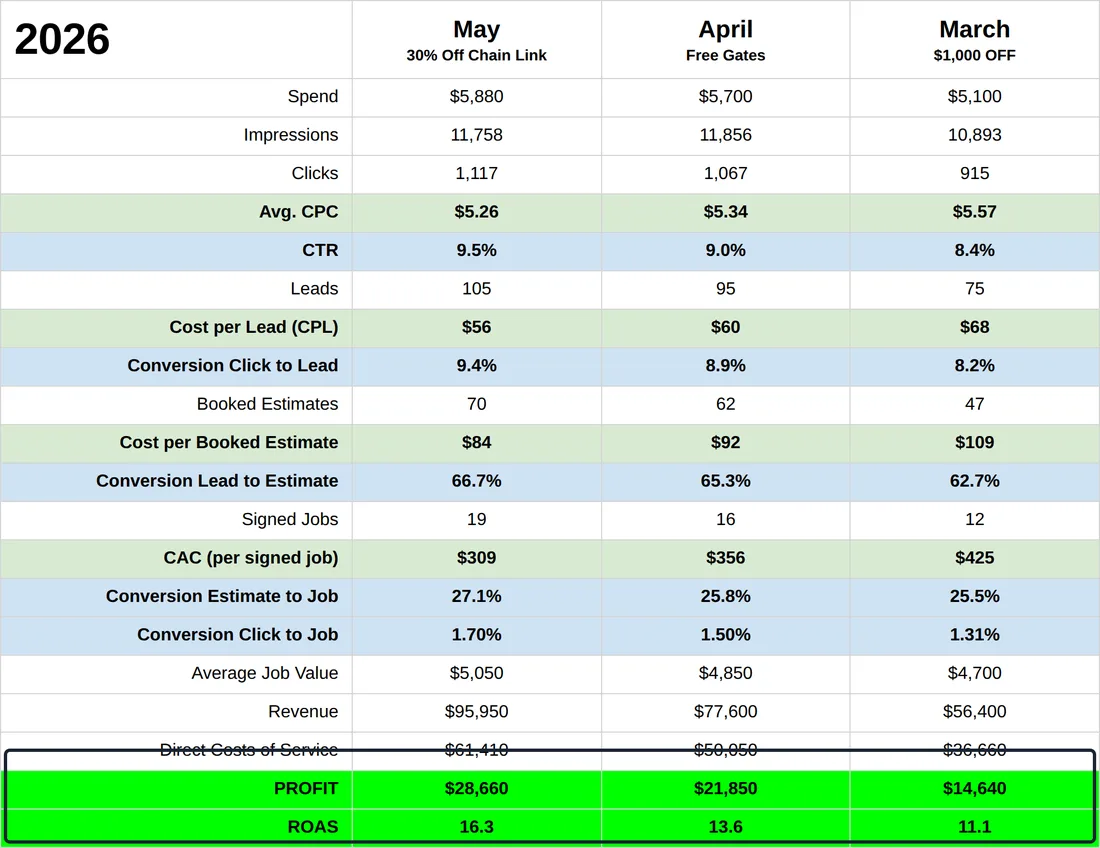
One example from home services: a fence company in North Dakota. In May 2026 a lead cost about $56, two out of three leads (67%) turned into a booked estimate, and each new customer cost $309 on an average job of about $5,000. There was no magic ad. The ads and the website showed why this company was worth choosing, every lead got a reply within minutes, every step had an owner, and no estimate was left without a next step.

I work alone — no account managers, no junior team. You always talk to me. I don’t just run ads: I build the sales side too — call scripts, follow-up messages, email templates — and I own how many leads turn into estimates and paid jobs.
Your next step: get the leads off the fridge

Done for you: work with me
A good fit if
- the business already makes steady money and you want to grow, not experiment;
- you’d rather be on jobs than learning ad platforms, websites and automations;
- you can put about $2,000 a month into marketing, ad spend included.
What I do
- Leads that turn into jobs. Your ads and website show why your company is worth the money — your work, your process, what’s included, your warranty, your reviews — so the people who reach out want results, not the lowest bid.
- Google and Meta ads — live in 3 days.
- A website or a page for your service — with a clear “book an estimate” button.
- No lead slips through — instant text and email after every lead, missed-call text-back, estimate booking, reminders after the quote.
- A sales system — call scripts, quote and email templates, rules for whoever answers the phone.
How I work
- No contracts. Pay by the week; stop any week.
- Everything is yours. Domain, website, ad accounts and customer list are in your name from day one.
- Reports in jobs: leads, booked estimates, quotes, paid jobs and what each job cost.
- You work directly with me. No account managers.
- No promised lead counts — I own the quality of the setup, the speed and honest numbers.
What changes
- One list instead of five places. You both see every lead, its status and who owns it.
- No more “I thought you called them back.” Every step has an owner and a deadline, and the reminder shows up on its own.
- Anyone at the phone sounds like an office. Scripts built for your service, and an answer to “how much?” that explains what the customer is paying for.
- You get your evenings back. First replies, reminders and quote follow-ups go out without you.
- Numbers instead of hunches. How many came in, how many booked, how many signed — once a week, on one screen.
- Cost: lead tracking and auto-replies — $69 a week plus one-time setup; sales scripts — $790 one time. Pay by the week, no contracts, and the customer list is yours.
Who this isn’t for
- You get a couple of calls a month and it really does all fit in your heads. Then you need customers first and a system second.
- Nobody in the family is willing to open an app and tap “estimate booked.” The system takes over the routine, not everything.
- You’re shopping for “lots of cheap leads.” I’m about leads that turn into jobs — and not losing them once they call.
Questions owners ask
My spouse handles it fine — why change anything?
Handling it fine is exactly why it’s worth taking the busywork off their plate. The system doesn’t replace them; it takes over what doesn’t need a human — first replies, reminders, quote follow-ups — and leaves time for the conversations that actually win jobs.
We’re not tech people
You need to open an app on your phone and tap a button or two. I set up everything else and walk you through it using your own leads.
Isn’t this overkill for a small family business?
Lead tracking and auto-replies are $69 a week. Run the math from this article on what one lost lead costs you. One saved job a month usually covers it with room to spare. Pay by the week, no contracts.
We tried a CRM before and gave up
Usually what people give up on isn’t the software — it’s the mess inside it, because nobody agreed who does what. I start with the rules — where a lead lives, who owns it, what goes out automatically — and the software just follows them.
What about busy season, when we’re both on jobs?
That’s when auto-replies and an AI receptionist matter most: it answers 24/7 and books estimates into your calendar. It doesn’t transfer calls to a person, but the customer is booked instead of calling your competitor.
Who owns the customer list?
You do. The customer list, the conversations and every record are in your company’s name from day one and stay with you, even if we stop working together.