This one is for fence company owners who pay for ads, or are about to, and want to know what a signed job actually costs them, not just a lead. I'm going to walk through a real report from a client, a fence company in North Dakota, line by line, from ad spend all the way down to profit. By the end you'll be able to run the same math on your own numbers in 15 minutes and see exactly where your money leaks.
In this article
- Sound familiar?
- A real report: May 2026, North Dakota
- What moved the numbers from March to May
- Three conclusions you'll want to draw, and shouldn't
- What's different about fence
- Why showing your value brings jobs, not just leads
- Work out your cost per job in 15 minutes
- Who I am and why I do this
- How to get this report for your business
- Who this isn't for
- Questions owners ask
Ask ten fence contractors what a customer from ads costs them, and nine will tell you their cost per lead. "I'm at $40 a lead." "We're at $25, our agency's killing it." Sounds like an answer. It's about as useful as judging a crew by how many posts they dropped off at the jobsite. Posts are nice. But nobody pays you for a pile of material by the garage. They pay you for a finished fence with a gate that latches.
A lead is a post. A signed contract is the fence. In between there's the estimate visit, the quote, the conversation with the homeowner's spouse, the HOA paperwork and that week of silence after you send the number. That's where your ad money either pays off or doesn't. Think that's overstating it? Here are the real numbers, no rounding in my favor.
Sound familiar?
🪵Plenty of leads, not many contracts
- The agency sends a report: "45 leads this month at $30." You scroll the list and recognize three people who actually signed. The rest wanted a "rough price per foot."
- You drive across town for an estimate, spend an hour walking the property line, and at the end the homeowner says, "Two more companies are coming out this week, we'll compare."
- Someone fills out your form, and they live two counties over where you don't work. Or they're asking if you're hiring.
📄Quotes that go quiet
- You sent an $8,000 quote as one line. The homeowner opened it, closed it and went dark. You have no idea what scared them: the price, the timeline, or not knowing what's in it.
- A second text feels pushy, so you don't send it. A month later you drive past their house and there's a brand-new fence. Not yours.
- By the end of the season there are twenty-some open quotes on your phone where nobody ever said yes or no.
📉No clue if the ads are working
- You pay for ads every month, but nobody can answer "what did one signed fence cost me?" Not the agency, not you.
- In summer the phone won't stop, you're on jobs till dark and missing calls. In winter you stare at an empty calendar and wonder if you should just shut the ads off.
- And there's that voice: maybe it's me. Maybe we're just too expensive. Even though every customer who actually hired you loves the work.
A real report: May 2026, North Dakota
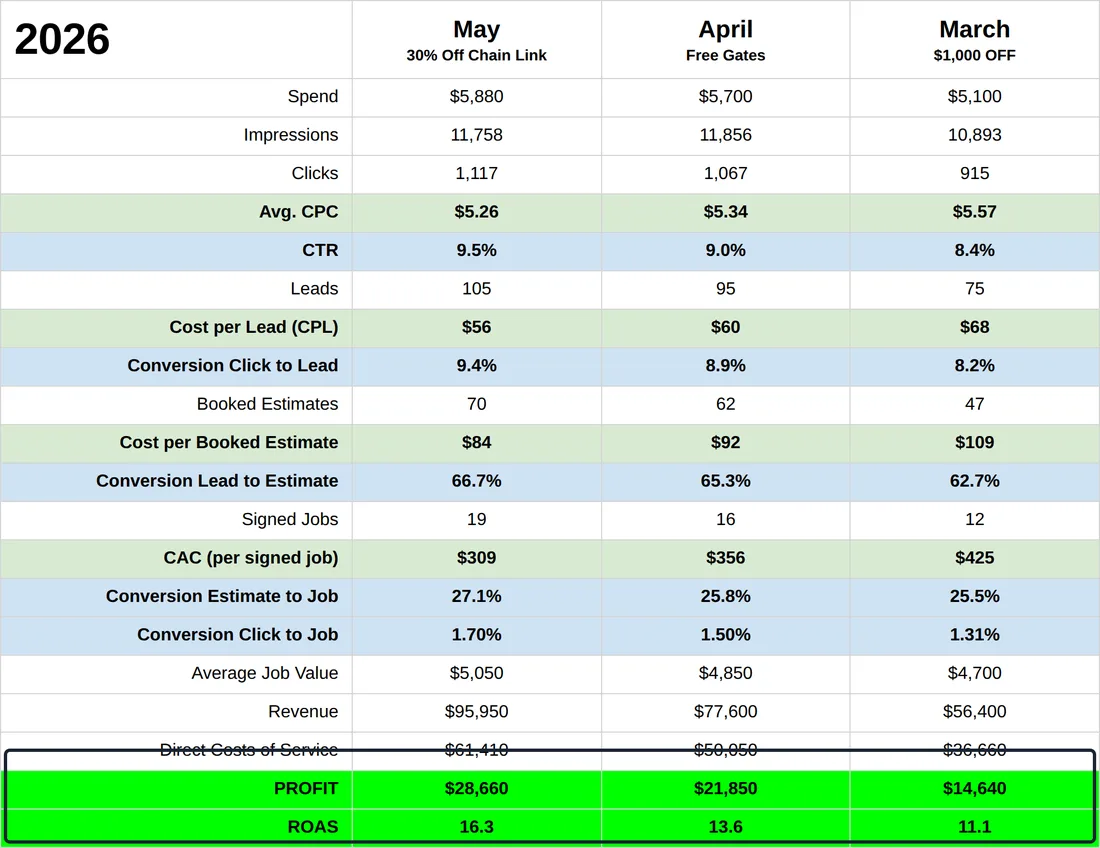
The client is a fence installation company. Google and Meta ads, their own website, every lead tracked in a CRM from first call to signed contract. Here's what May looked like, step by step, the way I read any report.
- Ad spend: $5,880. Everything that went to Google and Meta that month, not counting my management fee.
- 105 leads at about $56 each. In March a lead cost $68. If you stop reading here, it looks like cheaper leads did all the work. They didn't, and you'll see why in a second.
- 70 booked estimates, 67% of leads. Two out of three people who reached out let someone walk their property. Each estimate cost $84 in ad spend.
- 19 signed jobs, 27% of estimates. Roughly one quote in four turned into a contract.
- $309 in ad spend per new customer. In March it was $425. That's the most important number on the page.
- Average job about $5,050, revenue $95,950. Ad cost per customer was about 6% of the contract.
- Profit after direct costs: $28,660. That's the point of the whole exercise. Not the number of leads, not their price, but the money the company kept.
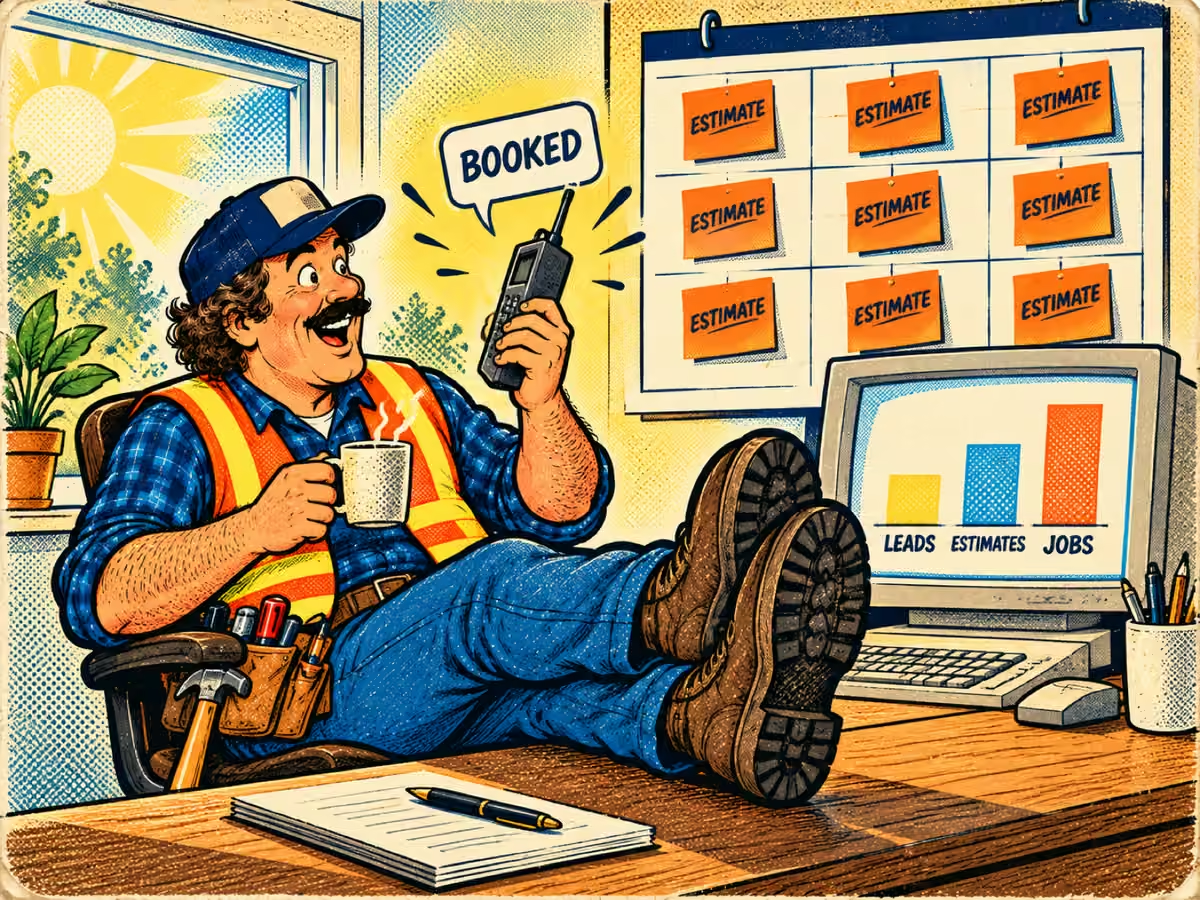
Now the interesting part. Over three months the cost per lead dropped 18%, from $68 to $56. The cost per customer dropped 27%, from $425 to $309. Where did the gap come from? From everything that happened after the lead came in. Divide cost per customer by cost per lead and you get how many leads it takes to sign one job. March: 6.25 leads. May: 5.5. The share of leads that became contracts went from 16% to 18%. Sounds small. Per ad dollar, it's real money.
For context: LocaliQ puts the average cost per lead from search ads in the Home & Home Improvement category at about $91 in 2026 (LocaliQ benchmarks). That category is broad, plumbers, roofers and interior designers all land in it, so it's not an apples-to-apples fence number. But it gives you the ballpark.
What moved the numbers from March to May
There was no magic setting in the ad account. There were five things, and every one of them makes sense to an owner without a marketing glossary.
- Leads got a reply in minutes, not that evening. A homeowner shopping for a fence often fills out two or three forms in a row. Whoever answers first and offers an estimate time is usually the one who shows up. Calling back at 7 p.m. is too late: they're already booked with someone else tomorrow.
- The ads and the page answered questions before the call. What materials: wood, vinyl, chain link, aluminum. How many gates and what kind. Who pulls the permit and handles the HOA. Who hauls away the old fence. What the warranty covers. Someone who read all that and still reached out isn't calling to "just get a price."
- Quotes came with options, not one scary number. "Fence: $9,800" on a single line scares people and sends them off to compare. Two or three options with a clear difference in material, height or gates turn "is this too expensive?" into "which one do we pick?" Completely different conversation.
- Every quote got a follow-up, not a prayer. Each quote had a next step: a reminder, an answer to the usual question, an offer to hop on a call. Not pushy, just what a contractor who actually cares would do.
- Every step had an owner. Who answers the lead, who runs the estimate, who follows up on the quote. No more "I thought you called them back."

Notice that only one of the five is about "ads" the way most people think of them. The other four are about what happens after the phone rings. That's why an agency that's only on the hook for leads can't be on the hook for jobs, even if it wanted to.
Three conclusions you'll want to draw, and shouldn't
"So the goal is a cheaper lead"
Makes sense on the surface: cheaper lead, cheaper customer. But look again. The customer got cheaper faster than the lead did. If the only goal were the cheapest possible lead, the easy move would be to strip prices, materials and terms out of the ads and invite everybody. Leads would get cheaper. Estimates would drop, because the phone would fill up with people collecting prices.
"I'll move the whole budget to wherever leads are cheapest"
Over the life of this account, Google Ads brought in 630 leads at about $49, and Meta brought in 272 leads at about $20, with the best ads under $11. The temptation is obvious: kill the pricey channel and pour everything into Meta. But that call gets made on how many signed jobs each channel produced and at what cost, not on the lead price in the dashboard. Someone who typed "fence company near me" and someone who saw your ad while scrolling are at different points in their decision. Sometimes the cheap scroll lead signs just fine, sometimes it doesn't. Only tracking all the way to the signature tells you which.
"I'll just quote lower and win the job"
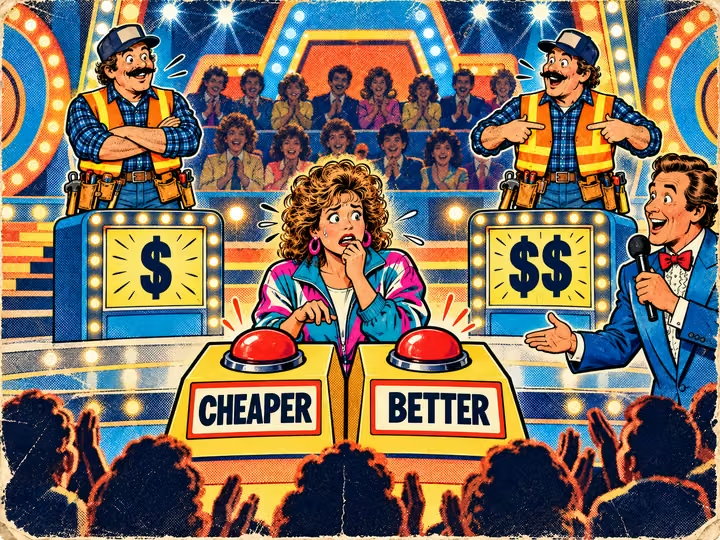
A fence is something the homeowner looks at every day for the next fifteen years. Plenty of them aren't hunting for the cheapest option. They're afraid of overpaying for who-knows-what. When your quote spells out where the money goes, posts set in concrete, board thickness, a self-closing gate, haul-away of the old fence, the warranty, comparing you to the lowest bid stops being a fair fight. A discount just eats your margin: 10% off a $5,000 job is $500 straight out of profit.
What's different about fence
- Season. Shorter up north, longer down south, but every spring turns into a race: everybody wants the fence "before summer." Whoever replies faster and gets out for the estimate first wins the season. And in winter it usually pays more to keep collecting estimates for spring than to shut the ads off and start from zero in March with everybody else.
- HOAs. In HOA neighborhoods the fence has to be approved: height, material, color. Homeowners dread it: "What if they reject it?" Say in your ads and on your page that you help with the HOA paperwork, and you remove the fear that makes people put the project off.
- Permits and utility lines. A lot of cities require a permit, and before anyone digs post holes, 811 has to be contacted so buried utilities get marked. The national 811 service lists installing fences among the projects that need it (811 Before You Dig). Homeowners rarely think about it. When you say "we handle that," you stop being just another number on their list.
- Materials and options. Wood, vinyl, chain link, aluminum, ornamental iron, each with its own price and lifespan. That's your good-better-best quote, ready-made. The homeowner chooses between your options instead of between you and the next guy.
- Neighbors. A fence goes up in front of the whole street. A yard sign during the install and a review request after the walkthrough set up the next job on the same block.

Why showing your value brings jobs, not just leads
There are two ways to advertise fences. One is "Fences. Best prices. Free estimate." That pulls in everyone looking for a lower number, and the leads will be cheap. The other is to show why your company is worth the money: what fences you build, how the job goes from estimate to final walkthrough, what's included in the price, what the warranty covers, what the neighbors say. You get fewer of those leads, and each costs more. But the people calling want a good fence, not the lowest line on a spreadsheet of five quotes.
It's the difference between a classified ad that says "lumber for sale" and a finished fence on display with a gate and a sign: "Turnkey. Permit and old fence removal included." Fewer people stop at the display. Every one who does is already picturing it in their backyard.
And an honest note. This client's numbers come from one market, one budget and one team that called back fast. In your town a lead might cost more or less, your season might look different and your average job might be bigger or smaller. I can't promise you "19 jobs a month," and I won't. What I can promise: you'll see the same chain of numbers every week and know exactly what each signed job cost you.
Work out your cost per job in 15 minutes
Grab last month and write down five numbers
- Total ad spend, all channels, including lead sites like Angi and Thumbtack.
- Total leads: calls, texts, website forms.
- How many of them you actually ran an estimate for.
- How many quotes turned into a signed contract.
- The average job size on those contracts.
Divide ad spend by signed jobs. That's your cost per customer. Divide that by your average job. That's how much of every contract goes to advertising. For the North Dakota client in May, it was about 6%.
If you're filling in numbers 3 and 4 from memory, that's your leak right there. If fewer than half your leads get to an estimate, the problem is response speed or who's calling you. If fewer than one quote in five signs, the problem is the quote and what happens after you send it.
Who I am and why I do this

I’m Eddie A. For 12+ years I’ve worked in marketing and sales: projects in 50+ industries, ad budgets up to $60,000 a month, and $12M+ in revenue attributed to campaigns I managed — in the U.S., Canada, the UAE, Turkey, Europe and Kazakhstan. I’m based in Apopka, Florida, and run a registered LLC.
- 12+years in marketing and sales
- 50+industries I’ve run ads for
- $60Kmax monthly ad budget
- $12M+revenue from my campaigns
One example from home services: a fence company in North Dakota. In May 2026 a lead cost about $56, two out of three leads (67%) turned into a booked estimate, and each new customer cost $309 on an average job of about $5,000. There was no magic ad. The ads and the website showed why this company was worth choosing, every lead got a reply within minutes, every step had an owner, and no estimate was left without a next step.
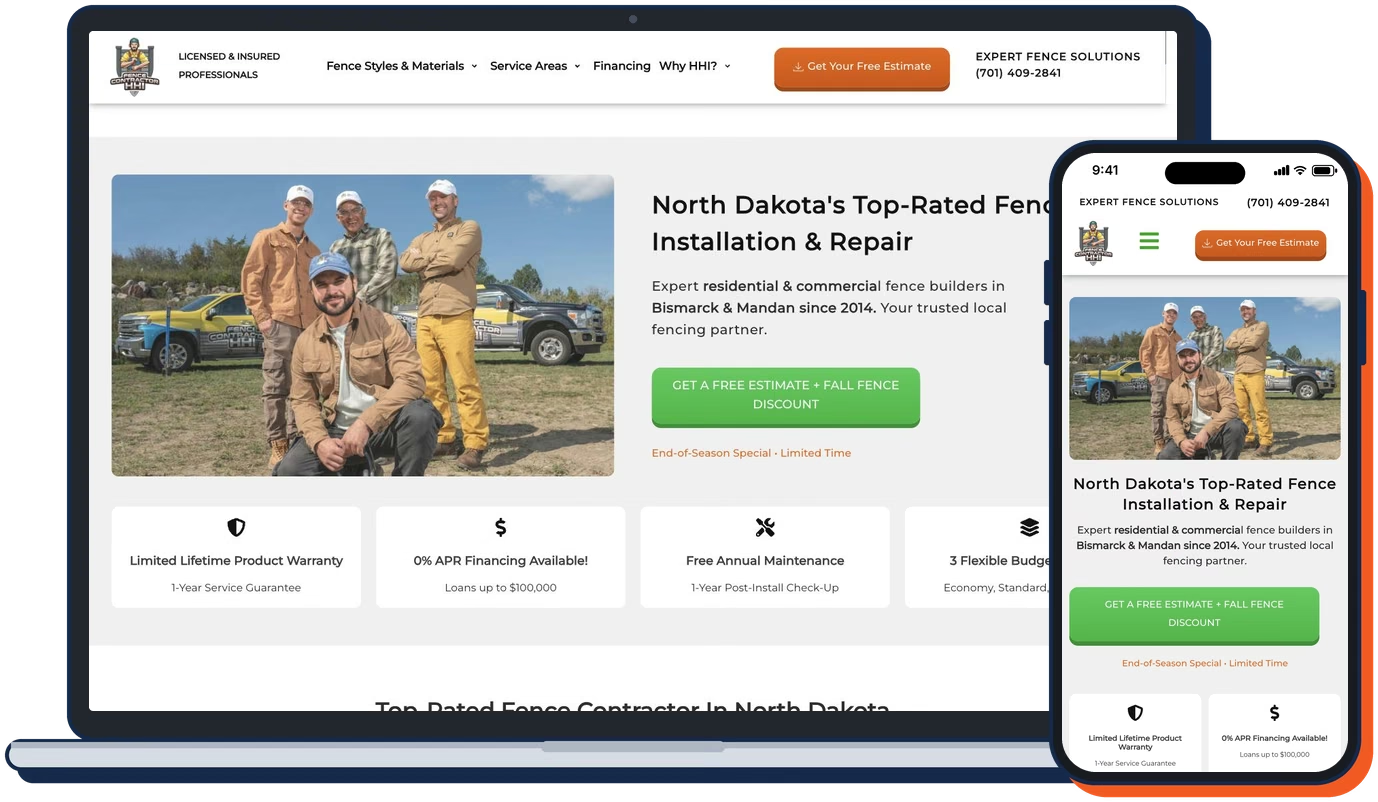
I work alone — no account managers, no junior team. You always talk to me. I don’t just run ads: I build the sales side too — call scripts, follow-up messages, email templates — and I own how many leads turn into estimates and paid jobs.
How to get this report for your business
Done for you: work with me
A good fit if
- the business already makes steady money and you want to grow, not experiment;
- you’d rather be on jobs than learning ad platforms, websites and automations;
- you can put about $2,000 a month into marketing, ad spend included.
What I do
- Leads that turn into jobs. Your ads and website show why your company is worth the money — your work, your process, what’s included, your warranty, your reviews — so the people who reach out want results, not the lowest bid.
- Google and Meta ads — live in 3 days.
- A website or a page for your service — with a clear “book an estimate” button.
- No lead slips through — instant text and email after every lead, missed-call text-back, estimate booking, reminders after the quote.
- A sales system — call scripts, quote and email templates, rules for whoever answers the phone.
How I work
- No contracts. Pay by the week; stop any week.
- Everything is yours. Domain, website, ad accounts and customer list are in your name from day one.
- Reports in jobs: leads, booked estimates, quotes, paid jobs and what each job cost.
- You work directly with me. No account managers.
- No promised lead counts — I own the quality of the setup, the speed and honest numbers.
Who this isn't for
- If you want a guaranteed number of leads a month. I don't give one. And if someone else does, ask them how many of those leads will turn into signed jobs.
- If you only compete on price and don't want to show in your ads and quotes what the homeowner is paying for.
- If there's nobody to run estimates. Ads bring people in, but the contract gets signed in the homeowner's backyard. Crew and time first, budget second.
Questions owners ask
My town and market are different. Will I get the same numbers?
No, and I won't promise you will. Lead cost depends on your city, competition, season and budget. Signed jobs depend on how fast you reply and what's in your quotes. What stays the same is the chain we track every week: leads, estimates, quotes, jobs and the cost of each job.
Do fence ads even make sense in winter?
Depends on your climate and your cash flow. Often it pays more to keep a smaller budget running and line up estimates and quotes for spring than to shut everything off and restart in March alongside every competitor. We decide that on your numbers, not on a template.
I already pay an agency and my leads are cheap. Why change anything?
Ask your agency for one number: what did one signed job cost last month? If nobody can answer, you're paying for leads, not jobs. If they can and you like the answer, great, stay put.
What does it cost?
Google Ads management starts at $220 a week, plus your ad spend, which you pay directly (at least $1,000 a month per channel), plus a setup fee. You pay weekly, no contracts: tell me by Friday and the next week isn't billed. Full pricing is on the pricing page.
Do you guarantee a number of leads or jobs?
No. I'm responsible for ads that show why your company is worth it, for making sure no lead slips through, and for honest weekly numbers all the way to the signed contract.
Who owns the website, the ads and the customer list?
You do, from day one. Ads run in your account, the leads are yours only and never resold. If you leave, you get all access and files within 3 business days, no penalty.
I don't have time to manage another vendor
You work directly with me, no account managers. I need your input on prices, materials and service area at the start, and a few minutes a week on the report. The rest is on me.