
This one is for subcontractors working under a general contractor, and for anyone who just opened their own home service company — fence, remodeling, concrete, painting, flooring, handyman. If your crew is booked almost every day but you take home less than $10,000 a month, keep reading. You’ll get the math on what the GC actually keeps, the bare-minimum setup that gets homeowners calling you directly, the three traps that eat most people’s first year, and a five-minute “am I ready to go out on my own” check. At the end: the fastest way to get a plan for your trade and your town.
In this article
- Sound familiar?
- What the GC actually keeps
- Three traps that eat your first year
- A lead can cost more — as long as it turns into a job
- The bare-minimum setup: 7 steps to start
- Ready to stop subbing? A 5-minute check
- Who I am and why I do this
- Your next step toward your own jobs
- Who this isn’t for
- Questions owners ask
Friday, 6 p.m. You just wrapped the job. Clean lines, no mess, and the homeowner walks out with her phone to snap photos. “This looks amazing. I’m telling all my neighbors.” And she will — about the GC. She wrote the $8,000 check to him, she’ll leave the review on his page, and she’ll hand her neighbor his number. You’ll get your cut whenever his office gets around to it.
I know what you’re thinking: “My own company means ads, a website, quotes, risk. At least now the work is steady.” Fair. So this isn’t a pep talk about freedom. It’s the numbers: what that steady work really costs you, and the minimum it takes for homeowners to call you instead of the middleman.
Sound familiar?
🔨Working more, earning the same
- The crew works six days a week, and your income hasn’t moved in a year. You don’t set the rate — he does.
- When the GC slows down, you slow down. You have no customers of your own, nobody to call, and the guys keep asking if there’s work next week.
- You pay for materials and payroll now. The GC pays you when it suits him.

🙈They love the work, not the name
- The homeowner raves about your work — on the GC’s review page. A year from now your craftsmanship is still selling jobs for him.
- The neighbor asks for your card, and it feels wrong to hand it over. She’s his customer, after all.
- Google your trade plus your town. You’re not there. At all.
😬Tried going solo, got burned
- You bought leads on a lead site. You reached two out of five, and both went with the guy who was cheaper and had 200 reviews.
- You gave your first customer a “review discount” and made less than you would have as a sub.
- An agency sold you a “starter package” with a 12-month contract. Barely any leads, and eight more payments to go.
- And the 2 a.m. thought: “Maybe this isn’t for me. Subbing is safer.”
If any of that hit home, your hands aren’t the problem. The GC doesn’t make more because he works better. He makes more because he has what you don’t have yet: homeowners find him, read his reviews and sign his quote.
What the GC actually keeps
The GC isn’t selling your labor to the homeowner. He’s selling confidence: they found him, they trust him, the quote makes sense and there’s a warranty behind it. That’s what he gets paid the difference for. It’s a fair deal — right up until you want to grow.
Same job, but the homeowner called you directly: $8,000 minus $2,200 in materials, minus $1,300 crew, minus $300–600 in marketing to land the customer. You keep $3,900–4,200.
To clear $10,000 a month as a sub, you need eight of those jobs. Selling direct, you need three.
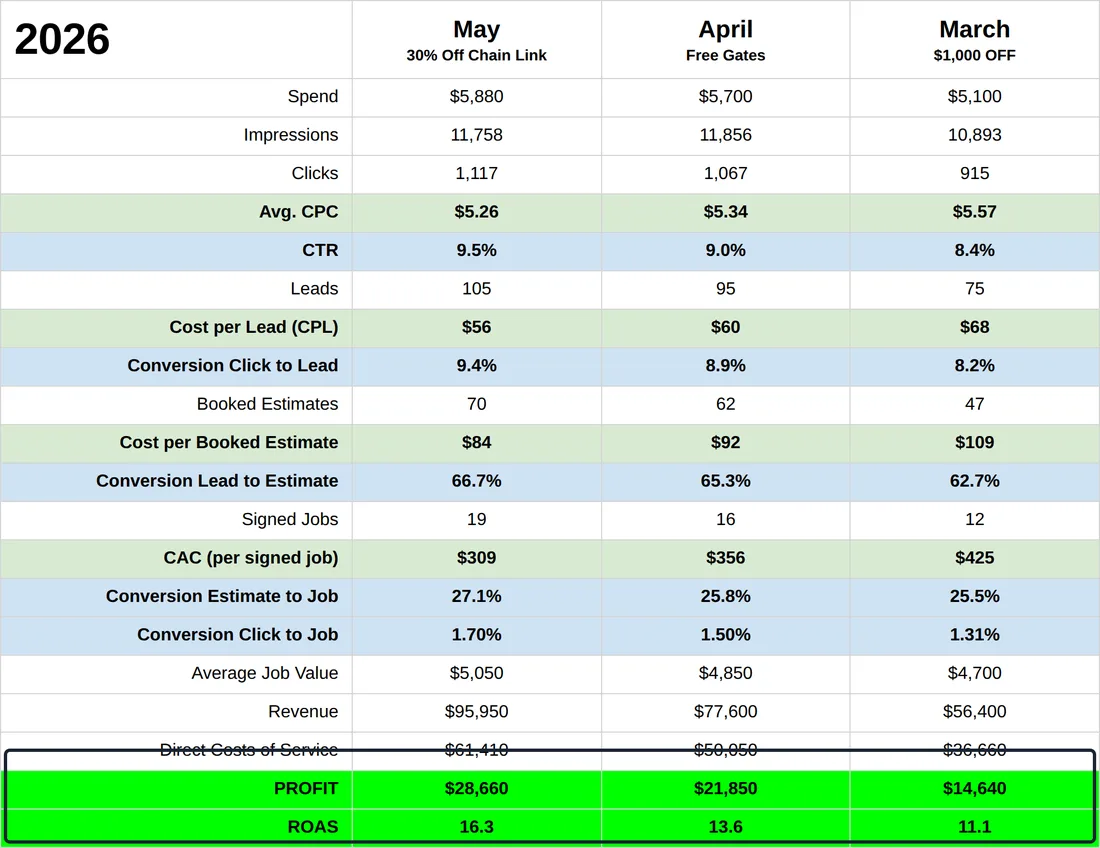
Where the $300–600 comes from: for one of my clients, a fence company, each new customer cost $309 in marketing in May 2026. Your number will be different — it depends on your trade, your town and how you handle leads. But the scale is clear: even if your marketing costs twice that, the gap is still huge.
The honest flip side: selling direct means more work. Quotes, texts, warranty calls, the unhappy customer — they’re all yours now. That’s exactly what the GC charges for. The question is whether you’re ready to take on that work along with the money.
Licensing, insurance, setting up the company — that’s not my lane. Every state has its own rules, so talk to a lawyer and an accountant. My lane is where the customers come from and how you get them to a signed quote.
Three traps that eat your first year

“I’ll buy leads from a lead site — it’s faster”
Makes sense on paper: no website, no reviews, and the customers are already there. But on lead sites the same lead often goes to several companies at once, and the homeowner compares. A new company with no reviews loses that comparison twice: the next guy has 200 ratings and he’s happy to drop his price. In 2023 the Federal Trade Commission ordered HomeAdvisor to pay up to $7.2 million: contractors were promised leads matching their services and area, and got plenty that didn’t.
“I’ll offer a discount to get my foot in the door”
It feels like a new guy needs to give people a reason to pick him. But a discount isn’t a reason, it’s a label. The homeowner remembers the price and tells the neighbor. Your next job starts at that price.
“I’ll sign up with an agency and let them handle it”
When you’re on jobs all day, handing it all off sounds great. The problem: a lot of agencies chase cheap leads. The report shows plenty of leads at a low price, everyone’s happy. In real life, one guy is price-shopping five companies, another lives 80 miles away, a third is looking for a job. For a new company with no reviews, those leads don’t turn into jobs at all. Add a 12-month contract and a website registered to the agency, and six months later you’ve got no money and no website.
“I’ll wait for word of mouth to kick in”
Word of mouth works — slowly, and with no steering wheel. The GC’s customers refer the GC. Your first five customers will tell five friends, and maybe one of them needs a fence, a year from now. Referrals are a great add-on to a system. They’re a bad replacement for one.
A lead can cost more — as long as it turns into a job
The market has trained everyone to judge marketing by how cheap the lead is. For a new company that’s especially dangerous: cheap leads come from people shopping for the lowest price, and somebody will always be lower than you.
So do the opposite from day one: show why your work is worth the money. Photos of your jobs — including ones you did as a sub, if the GC is fine with it. How the job goes, step by step. What’s included in the price and what won’t show up as an extra. Your warranty. Your first reviews. Then the people who call aren’t dialing every number on the list — they want the job done right. You get fewer leads, and each one costs more. But those are the leads that book the estimate and sign the quote.
Picture two trucks in the Home Depot parking lot. One has “Fence. Cheap. Call” in Sharpie on the door. The other has a clean decal, a photo of a finished fence and “2-year warranty.” Which one does a homeowner trust with an $8,000 backyard? A company with no reviews can only afford to be the second truck.
The bare-minimum setup: 7 steps to start

- A Google Business Profile — it’s free, and you don’t need a storefront: you can list the areas you serve. Services, areas, hours, 10–20 photos of your work. Done when the profile is verified and someone who finds you on the map gets what you do in five seconds.
- Your first honest reviews — ask every customer, right after the job, with a link by text. Don’t pay for reviews, don’t trade a discount for one, and don’t ask only the happy customers: Google’s rules prohibit it, and fake reviews are flat-out banned under the FTC rule from 2024. Goal: your first 10.
- A simple page — one page, not a 30-page website. What you do, where, photos, how the job goes, what’s included, your warranty and one “Book an estimate” button. Done when a stranger reads it all the way down to the button.
- Your market numbers — how many people in your town search for your service and roughly what a lead costs. Without that, ads are a lottery: you can’t tell whether you’re getting too few leads or your town just doesn’t have the demand.
- A small first ad campaign with a stop rule — decide up front how much you’ll spend before you check. For example, the amount that, based on your market numbers, should bring in 5–7 leads. If that money produces zero booked estimates, stop and find the break: the ad, the page or the follow-up.
- Instant replies — while you’re up a ladder, the homeowner is calling the next number on the list. A missed-call text-back and a reply to every lead within minutes, not tonight. Done when no lead waits longer than your coffee break.
- A quote that shows value — not a number in a text, but a real document: what’s included, which materials, timeline, warranty, a photo of a similar job and the next step. Plus a follow-up a couple of days later if they go quiet. A bare “$8,000” gets compared to someone else’s number. A clear quote gets compared to someone else’s vague one.
Why aim for your first 30 jobs? There’s nothing magic about 30. It’s the point where you have reviews, photos, a process that works and your own numbers: how many leads booked an estimate, how many quotes got signed, what each job cost you. With those numbers you can turn up the ads calmly — you already know what comes back. Without them, every decision is a guess.
One more piece of advice that will save you some sleep: don’t quit the GC overnight. Keep subbing until your own jobs cover at least half the month. Freedom is great once you can pay for it.
Ready to stop subbing? A 5-minute check
Answer honestly, with numbers
- How much do you keep from one job as a sub, after materials and crew?
- What does the homeowner pay for that same job?
- Do you have a Google Business Profile with photos and at least five reviews?
- Do you know how many people in your town search for your service every month?
- Who replies to a new lead within five minutes while you’re on a job?
- Could you cover two or three slow months if the GC sends you less work?
The gap between questions 1 and 2 is what you pay every time a homeowner finds the GC instead of you. Questions 3–5 are the pieces to build first. If the answer to 6 is “no,” build the system while you keep subbing: a profile, reviews and a simple page cost little beyond your time.
Who I am and why I do this

I’m Eddie A. For 12+ years I’ve worked in marketing and sales: projects in 50+ industries, ad budgets up to $60,000 a month, and $12M+ in revenue attributed to campaigns I managed — in the U.S., Canada, the UAE, Turkey, Europe and Kazakhstan. I’m based in Apopka, Florida, and run a registered LLC.
- 12+years in marketing and sales
- 50+industries I’ve run ads for
- $60Kmax monthly ad budget
- $12M+revenue from my campaigns
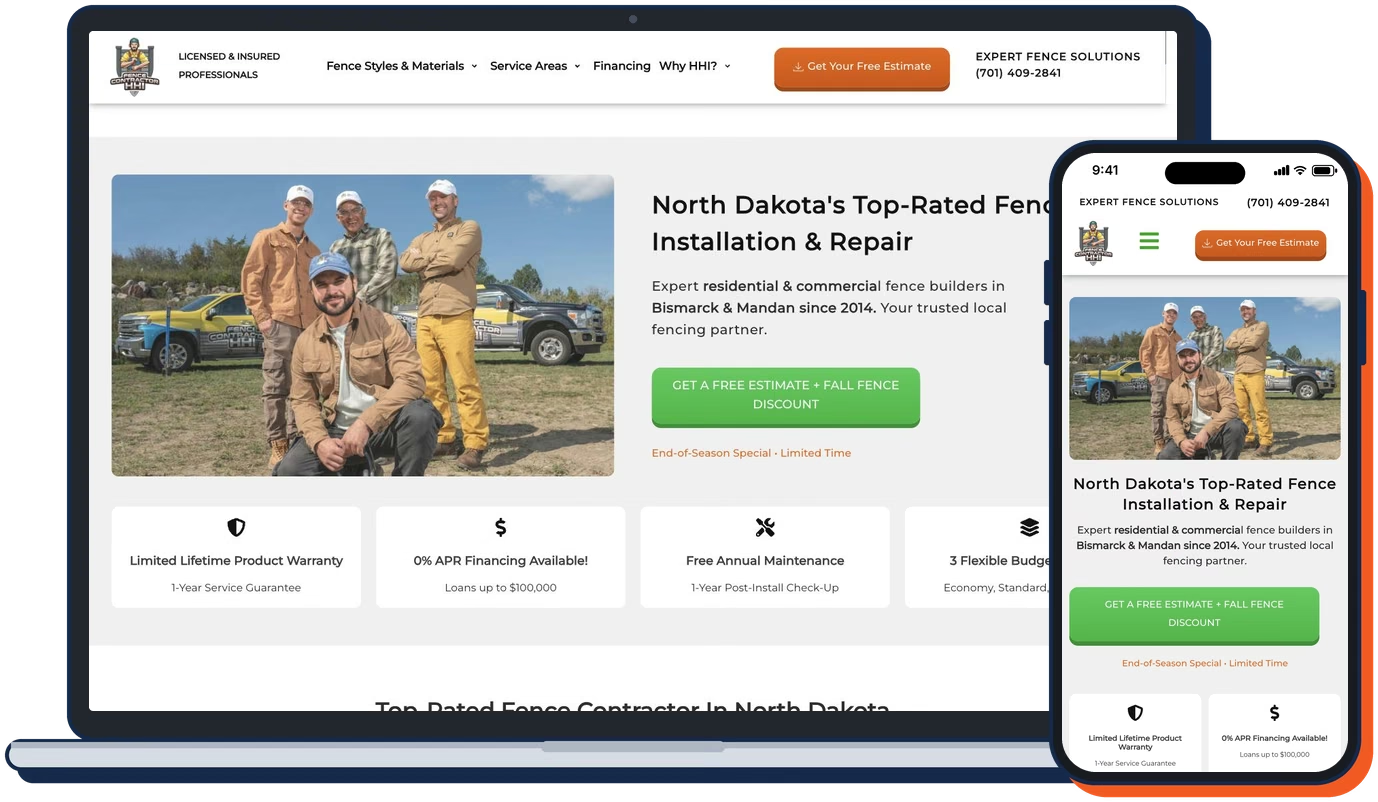
One example from home services: a fence company in North Dakota. In May 2026 a lead cost about $56, two out of three leads (67%) turned into a booked estimate, and each new customer cost $309 on an average job of about $5,000. There was no magic ad. The ads and the website showed why this company was worth choosing, every lead got a reply within minutes, every step had an owner, and no estimate was left without a next step.
I work alone — no account managers, no junior team. You always talk to me. I don’t just run ads: I build the sales side too — call scripts, follow-up messages, email templates — and I own how many leads turn into estimates and paid jobs.
Your next step toward your own jobs
Straight talk: if you’re under $10,000 a month, hiring an agency may be early. Start with the free growth plan call — I’ll check the demand for your trade in your town, look at your Google profile and give you a 4-week plan. You can follow it yourself with the seven steps above; the plan is yours either way. When you’re ready to spend about $2,000 a month on marketing, ad spend included, and want me to build the system while you’re on jobs — that’s the done-for-you option below.

Done for you: work with me
A good fit if
- the business already makes steady money and you want to grow, not experiment;
- you’d rather be on jobs than learning ad platforms, websites and automations;
- you can put about $2,000 a month into marketing, ad spend included.
What I do
- Leads that turn into jobs. Your ads and website show why your company is worth the money — your work, your process, what’s included, your warranty, your reviews — so the people who reach out want results, not the lowest bid.
- Google and Meta ads — live in 3 days.
- A website or a page for your service — with a clear “book an estimate” button.
- No lead slips through — instant text and email after every lead, missed-call text-back, estimate booking, reminders after the quote.
- A sales system — call scripts, quote and email templates, rules for whoever answers the phone.
How I work
- No contracts. Pay by the week; stop any week.
- Everything is yours. Domain, website, ad accounts and customer list are in your name from day one.
- Reports in jobs: leads, booked estimates, quotes, paid jobs and what each job cost.
- You work directly with me. No account managers.
- No promised lead counts — I own the quality of the setup, the speed and honest numbers.
Who this isn’t for
- If you’re happy subbing. That’s a legit choice: steady work, no selling. Then this article isn’t for you.
- If you want a guarantee of “30 jobs in a month.” I don’t give one — and don’t trust anyone who does.
- If you can’t free up a single evening a week for your profile, reviews and quotes. This doesn’t build itself.
- If you’re looking for a way to buy reviews. That’s the shortcut to a suspended profile.
Questions owners ask
What about licensing, insurance and setting up the company?
Not my lane — every state has its own rules, so talk to a lawyer and an accountant. My lane is where customers come from and how you get them to a signed quote.
Won’t the GC be upset if I start finding my own customers?
Don’t poach his customers and there’s nothing to argue about. Your own system brings in new people from Google, not the ones he sent you. And don’t quit overnight: keep subbing until your own jobs cover at least half the month.
I barely have money for ads
Then start with what’s nearly free: a Google Business Profile, your first reviews, a simple page and a solid quote. Turn on ads once that’s ready and you know your market numbers — and set a stop rule from day one.
How long until I get my first direct jobs?
Honestly, it depends on your trade, your town and how fast you build the basics. A profile and a simple page can be done in a couple of weeks, the first ads right after. I won’t promise “30 jobs in a month.”
I’ve been burned by a lead site or an agency before
That’s why everything here is in your name: your profile, your page, your reviews, your ad account. When you work with me there’s no contract — you pay by the week and can stop any week.
What does the growth plan call cost?
Nothing. It’s 30 minutes: I check demand for your service in your area, look at your Google profile and give you a 4-week plan. It’s yours to keep, even if we never work together.
What does it cost to work with you?
Managing one ad channel starts at $220 a week, plus your ad spend and a setup fee. Every plan is on the pricing page. No long-term contracts.