This article is for owners of home service companies that have been in business two years or more: fencing, remodeling, roofing, HVAC, cleaning, landscaping, it doesn't matter. If your phone, your QuickBooks or a notebook in the truck holds hundreds of people who already paid you or had you out for an estimate, you're sitting on money you don't have to buy with ads. I'll show you who's in that list, what to send them and when, how often to reach out without becoming a pest, who you can text and who only gets email, and a 15-minute way to estimate what the list is worth. At the end: one clear next step if you'd rather have it built for you.
In this article
- Sound familiar?
- Why a past customer beats any ad
- Who's sitting in your old list
- Why the usual attempts fall flat
- What to send, and when
- How often to reach out without being a pest
- Texts and emails: the simple rule
- How to set it up in five steps
- What your list might be worth
- Who I am and why I do this
- Where to go from here
- Who this isn't for
- Questions owners ask
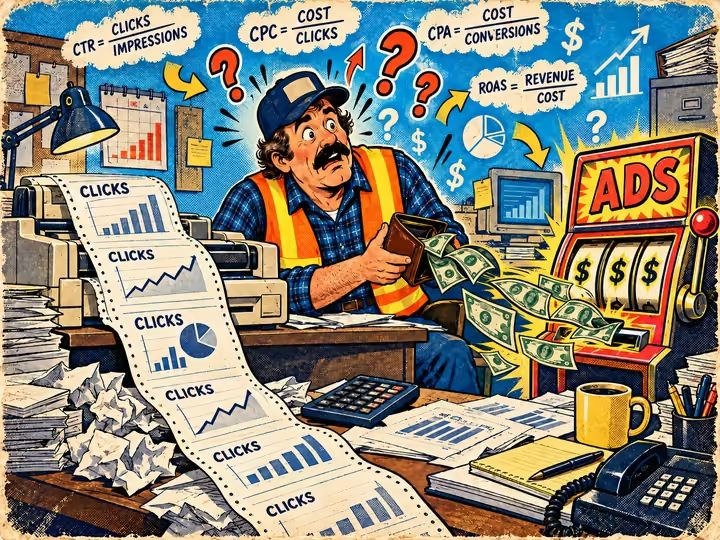
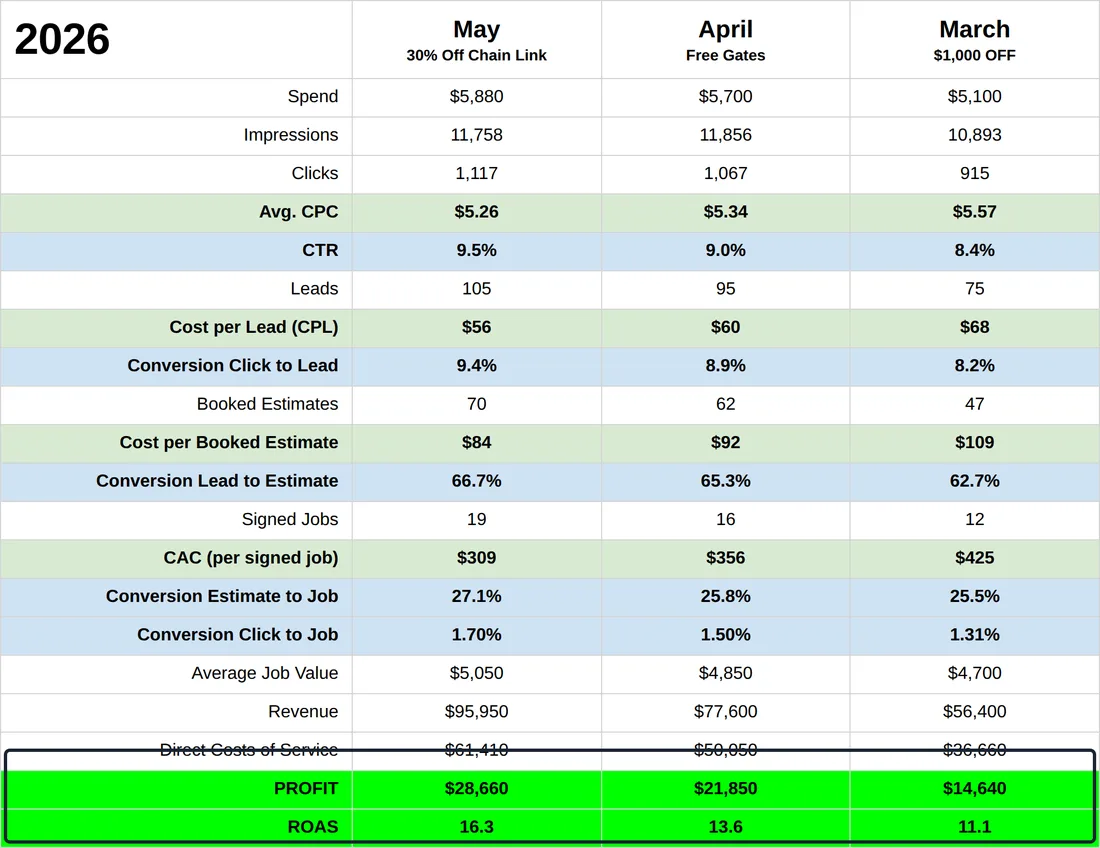
For a lot of owners, Monday starts the same way: how many new leads came in, and should we bump the ad budget. A new customer costs money before you've even shaken hands. At a fence company where I run the ads, landing one new customer in May 2026 cost $309 in ad spend, and that's a good number. It took three months of work to get there.
Meanwhile your phone holds 400, 600, 900 contacts. People who watched your crew work, paid you, and were most likely happy with the job. Some of them have hired another contractor since, simply because you never reached out once. "Nobody reads that marketing stuff," you might say. If it's a "Happy Holidays" blast once a year, you're right, nobody does. Below I'll show you what to send so people actually reply, and run the numbers on an example so you can see what it's worth in dollars.
Sound familiar?
🏠Past customers drift to other companies
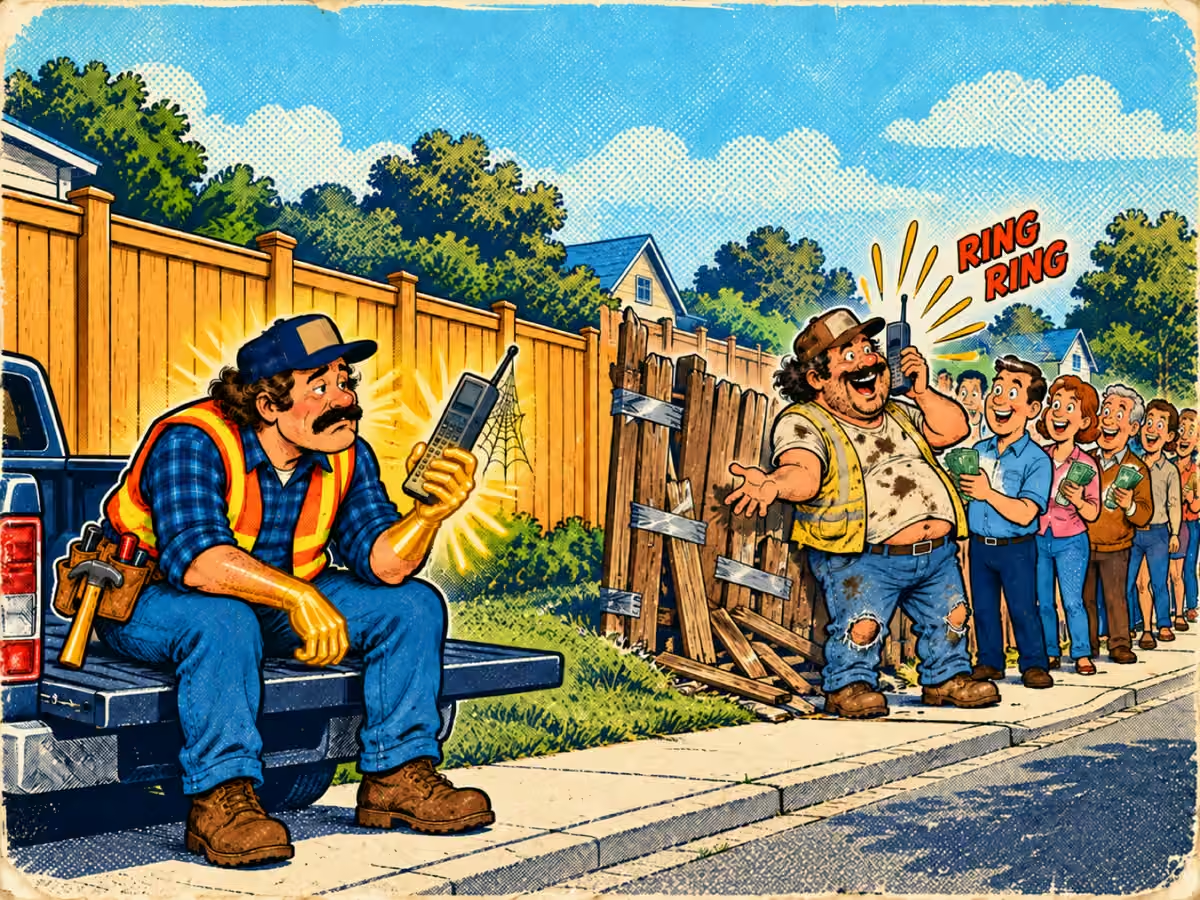
- You drive past a house where you built the fence three years ago, and there's a competitor's truck in the driveway putting in a gate and lighting. The homeowner loved your work. When she needed a gate, she just couldn't remember your company name, so she Googled and called whoever came up first.
- Your customer's neighbor asks who did the fence. He scrolls through his phone, can't find your number and says, "Some guys. They did a good job."
- The family whose kitchen you remodeled started on the master bath two years later. You found out on Facebook, from photos of somebody else's work.
📄Quotes that died quietly
- Over the year you've piled up a stack of quotes that ended with "we'll think about it." Every one of them cost you gas, an evening and your expertise for free.
- The homeowner said, "Let's do it in the spring." Come spring you were slammed and never followed up. Neither did they, and they hired whoever showed up in front of them in March.
- Calling six months later feels awkward, like you're begging for work. It doesn't occur to you that they might be waiting for your call and just got busy.

📇You have a list. Kind of
- Contacts are everywhere: some in your phone, some in QuickBooks, some in your wife's notebook, some in texts on your old number.
- "This winter I'll sit down and reach out to everybody," you tell yourself for the third winter in a row.
- Every January you start from zero like it's year one, even though you have hundreds of finished jobs behind you.
If this sounds like you, it's not laziness and it's not your work. You did exactly what the market trains you to do: chase new customers. Lead sites, agencies and ad platforms all sell new customers. They can't make money on the ones you already have, so nobody ever reminds you they exist.
Why a past customer beats any ad
A new customer has a long road to travel: find you, compare you with three other companies, trust reviews written by strangers, and let a crew they've never met into their backyard. They can drop off at any step, and at every step you pay, in ad spend, in time for the estimate, in the discount they talked you into after comparing quotes.
A past customer already made that trip. They know you'll show up. You don't have to explain why your fence costs more than the guy's on Craigslist; they've watched yours stand straight through three winters. Everything your ads and website have to do for a stranger, show why your company is worth the money, is already done with this person. You did it with your own hands.
In business overall, this has been measured for years. As Harvard Business Review puts it, acquiring a new customer is anywhere from five to 25 times more expensive than retaining an existing one. That figure is general, not specific to home services, so don't treat it as a rule for your trade. But every contractor gets the direction: someone who already said yes to you will say it again faster than a stranger will.
Think of a good mechanic. You don't shop for a new one every time the check engine light comes on; you call your guy. But if your guy hasn't been in touch once in five years, and there's a billboard by the highway with another shop's number, one day you'll call the billboard. Not because that shop is better. Because it was right in front of you.
Who's sitting in your old list
When an owner tells me "I don't really have a list," there are usually at least four groups of people. They've just never been in one place.
- Past customers. They need maintenance, add-ons and their next project. After a fence: a gate, lighting, staining. After a kitchen: a bathroom or a closet. After an AC install: seasonal tune-ups. After a roof: an inspection after storm season. These people aren't shopping for a contractor; they just don't know you do that too.
- Unsigned estimates. The hottest group. They invited you over, walked you around the yard and heard the price. "No" here often means "not now": money was tight, wrong season, a kid's wedding, tax time. Six months later things change, and your quote is still the only one they've seen.
- People who referred you. Everyone who ever sent you a neighbor or a friend is a free sales team. Most of them never even got a thank-you. Say thanks, and they'll send more.
- Inquiries that never got an estimate. Called in December when you weren't taking work. Asked for a price and went quiet. Booked an estimate and didn't answer the door. They were interested in your service, and they may still not have hired anyone.
Why the usual attempts fall flat
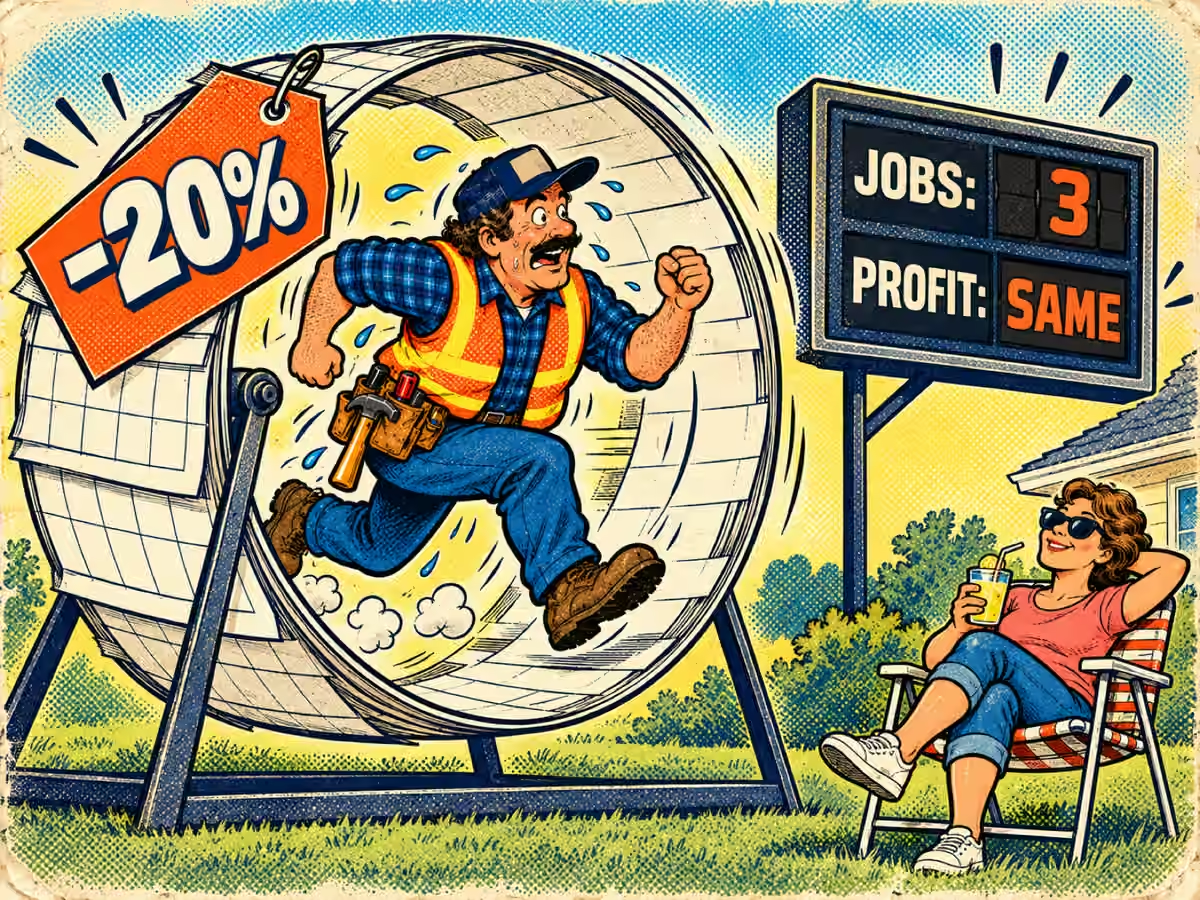
"I'll send everyone 20% off"
It seems logical: a discount is an easy reason to reach out. But your past customers didn't pick you for price, they picked you for the work. A discount tells them the opposite: "we're like everybody else, just cheaper this week." It trains them to wait for the next sale and takes money from people who would have paid full price.
"I'll send holiday cards"
Nice, and useless. Nobody replies to a holiday card with "Merry Christmas, also I need a gate." There's no reason in it, nothing useful for them, and no simple step they can take right now. It goes into the drawer with a hundred other cards.
"I'll do it when I have time"
The time shows up in winter, and in winter it feels like there's nothing to say. In spring there's plenty to say and no time. Result: three years of silence. If working your list depends on the owner having a free evening, it never happens. It needs to be planned out once, a year ahead.
"I'll text them every week so they don't forget me"
That's the other extreme. The guy you built a fence for doesn't want weekly fence news. A month in, he unsubscribes. Two months in, he replies "STOP." And when the neighbor asks about you, he doesn't say "good company," he says "they won't leave me alone."
"I'll buy software and it'll send everything for me"
Software sends whatever you load into it, to whoever you pick. Without groups, reasons to reach out and a person who answers the replies, it's just a spam machine with a monthly subscription.
What to send, and when
One rule: every message has a reason that's useful to the customer and one simple next step: reply YES, pick a time, tap a booking link. And talk about value, not discounts: what the check-up includes, what you'll look at, how it saves them money down the road. It's the same as a good ad: the customer should understand why it's worth their money, not why it's cheaper today.
- Seasonal check-up. Right before the season when things break or get worked hard: gates and posts after winter, the AC before the heat, the roof after storm season.
- Maintenance. Anything that needs care over time: staining and sealing wood, sealing concrete, pressure washing, small repairs. Homeowners often don't know it's needed until it's too late.
- Add-on services. Tied to what you already did: a gate for the fence, lighting for the deck, storage after the garage floor. Send photos of a similar job; they beat any description.
- "We're booking spring." When your schedule for the season actually opens, reach out to everyone who put it off. Only the truth: don't say "two spots left" if you have twenty.
- Job anniversary. "It's been a year since we built your fence. How did it hold up this winter?" Almost nobody sends this, which is exactly why people remember it.
- Unsigned estimates. A short sequence: a couple of days later, answer their questions; a couple of weeks later, show a similar job; right before the season, offer to update the quote with current prices.
Sample texts you can adapt
- Past customer, seasonal check-up: "Hi Mike, it's Alex from [Company]. We built your fence back in 2023. Spring is a good time to check gates and posts after winter. Want me to stop by for a quick look? Reply YES and I'll send a couple of times."
- Unsigned estimate before the season: "Hi Sarah, Alex from [Company]. You asked us about a cedar fence last fall and decided to wait until spring. We're scheduling April installs now. Want me to update your quote with current prices?"
- Add-on: "Hi Tom, Alex from [Company] here. If you've thought about adding a matching gate or lighting to your fence, reply and I'll send photos of similar jobs and a ballpark price."
- Anniversary: "Hi Linda, it's been a year since we finished your kitchen. How is everything holding up? If anything needs attention, just reply and we'll take a look."
Make them yours. And never promise something that isn't happening: if you say "I'll update your quote," update it. If you say "I'll stop by," stop by.
How often to reach out without being a pest
A good neighbor waves when he drives by and invites you over for a cookout a couple of times a summer. A bad one knocks on your door every day. The difference isn't manners. The first one always has a reason.
- Past customers: when there's a reason, not on a schedule. In my experience, 4 to 6 messages a year is plenty.
- Unsigned estimates: a short sequence in the first few weeks, then again before the season. Three messages with no reply means you wait for the next real reason.
- One message, one idea, one step. Not three offers at once.
- From a person, not "Dear Valued Customer." People reply to people.
- They said "don't contact me"? They're off the list for good. That's about respect, not just rules.
Texts and emails: the simple rule
I'm not a lawyer, so this is a rule of thumb, not legal advice. Only text offers to people who agreed to get texts from you: they checked the box on your website form, signed a consent line in your contract, or asked you to text them. Federal telemarketing rules treat a text like a call, and marketing messages to cell phones need prior express written consent. Everyone else gets email.
Email has rules too. The FTC spells it out: a message to former customers announcing a new service is a commercial email, and CAN-SPAM applies. Every one needs a clear way to opt out and your physical mailing address, and opt-out requests have to be honored within 10 business days. If you're unsure about something specific, half an hour with a lawyer costs less than one mistake.
And going forward: add SMS consent to your website forms and your contract, with wording your lawyer has looked at. A year from now you'll have a list you can text without second-guessing.
How to set it up in five steps
- Get the list in one place: phone, QuickBooks, notebook, email. The result is one list: name, phone, email, address, what you did and when.
- Sort it into groups: customers by year and service, unsigned estimates, people who referred you, inquiries with no estimate. And mark who gave consent to text.
- Plan a year of reasons to reach out: 4 to 6 reasons that fit your season and your trade. You write it once, and it works every year.
- Decide who answers: a customer replies YES on Saturday night. Who calls back, and how fast? A past customer who never hears back is a worse loss than a stranger.
- Keep score: how many replied, how many booked an estimate, how many signed and for how much. Without it, a month from now you'll be saying "I think a few came in."
In my system this runs on its own: messages go out on schedule, replies land in one inbox, every YES turns into a task with a deadline, and anyone who opts out never gets another message. More on the follow-up system page. But you can start with a spreadsheet and your phone. What matters is the calendar and one person who owns it.
What your list might be worth
Size up your list in 15 minutes
- How many customers have you served in the last 2–3 years? A rough number is fine.
- How many quotes from the last 12 months never got signed?
- When did you last reach out to these people with an actual reason, not a holiday card?
- What could you offer a past customer right now: a check-up, maintenance, an add-on?
- Who on the list agreed to get texts, and who can only get email?
- If 15 people replied tomorrow, who would answer them?
Back-of-the-napkin math: past customers × 1% × your average add-on ticket, plus unsigned estimates × 3% × your average job. Those are the same rates as the example above: 4 jobs out of 400 and 2 contracts out of 60. If even those modest numbers beat a month of ad spend, you know where to start.
If the answer to question 3 is "I don't remember" and to question 6 is "nobody," your list is dead weight. The good news: fixing that doesn't take an ad budget.
Who I am and why I do this

I’m Eddie A. For 12+ years I’ve worked in marketing and sales: projects in 50+ industries, ad budgets up to $60,000 a month, and $12M+ in revenue attributed to campaigns I managed — in the U.S., Canada, the UAE, Turkey, Europe and Kazakhstan. I’m based in Apopka, Florida, and run a registered LLC.
- 12+years in marketing and sales
- 50+industries I’ve run ads for
- $60Kmax monthly ad budget
- $12M+revenue from my campaigns
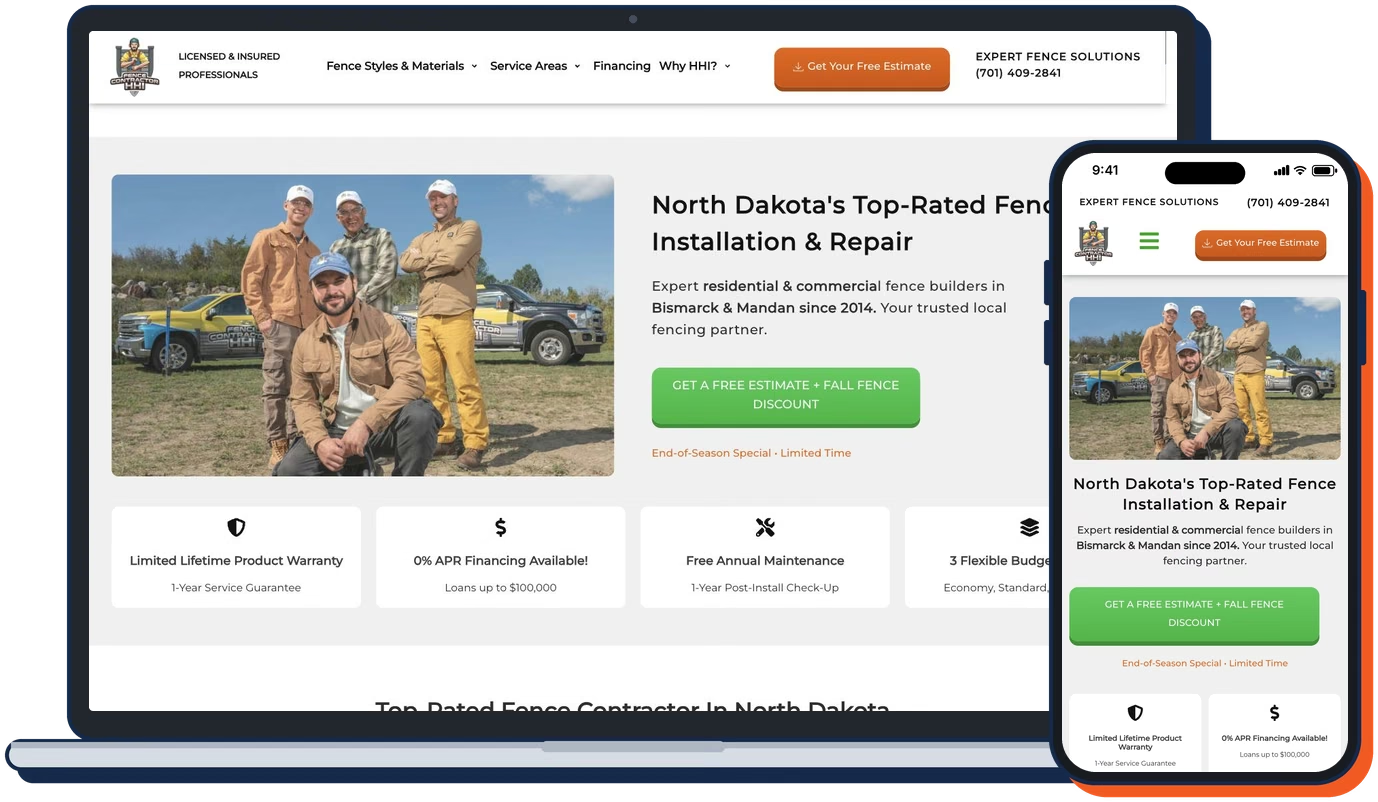
One example from home services: a fence company in North Dakota. In May 2026 a lead cost about $56, two out of three leads (67%) turned into a booked estimate, and each new customer cost $309 on an average job of about $5,000. There was no magic ad. The ads and the website showed why this company was worth choosing, every lead got a reply within minutes, every step had an owner, and no estimate was left without a next step.
I work alone — no account managers, no junior team. You always talk to me. I don’t just run ads: I build the sales side too — call scripts, follow-up messages, email templates — and I own how many leads turn into estimates and paid jobs.
Where to go from here
Done for you: work with me
A good fit if
- the business already makes steady money and you want to grow, not experiment;
- you’d rather be on jobs than learning ad platforms, websites and automations;
- you can put about $2,000 a month into marketing, ad spend included.
What I do
- Leads that turn into jobs. Your ads and website show why your company is worth the money — your work, your process, what’s included, your warranty, your reviews — so the people who reach out want results, not the lowest bid.
- Google and Meta ads — live in 3 days.
- A website or a page for your service — with a clear “book an estimate” button.
- No lead slips through — instant text and email after every lead, missed-call text-back, estimate booking, reminders after the quote.
- A sales system — call scripts, quote and email templates, rules for whoever answers the phone.
How I work
- No contracts. Pay by the week; stop any week.
- Everything is yours. Domain, website, ad accounts and customer list are in your name from day one.
- Reports in jobs: leads, booked estimates, quotes, paid jobs and what each job cost.
- You work directly with me. No account managers.
- No promised lead counts — I own the quality of the setup, the speed and honest numbers.
Who this isn't for
- If you've been in business less than a year and have a handful of customers. You need new customers first; the list has nothing to grow from yet.
- If you want to buy a list of strangers' numbers and blast offers to it. That isn't working your customer list, it's a fast track to complaints.
- If you're booked solid for the next six months. Then set this up for the slow season, not now.
- If you're waiting for a magic message that makes the phone explode by tomorrow. This works like a season: reasons, replies, estimates, signed jobs.
Questions owners ask
Won't I come across as pushy?
Pushy is messaging every week with no reason. "It's been a year since we built your fence, how did it handle the winter?" reads like you care, not like an ad. Anyone who isn't interested will say so, and you stop.
My list is in my phone and a notebook. I don't have a CRM
That's most owners. Step one is getting it all into one spreadsheet; even 300 rows is an evening or two. If we work together, I move the list into my system myself and sort it into groups.
My customers only need a fence or a roof once every 20 years
Then don't count on repeat jobs; count on maintenance, add-ons and referrals. When a neighbor asks who did the fence, a customer you recently checked in with will give your name, not "some guys."
Can I text everyone whose number I have?
No. Text offers only to people who agreed to get texts from you. Everyone else gets email with an unsubscribe link and your mailing address. That's a rule of thumb, not legal advice; for anything gray, ask a lawyer.
I don't have time for this
The calendar of reasons gets written once a year, and sending can be automated. Your time goes into answering replies, and those are conversations with people who want to hire you. If we work together, I set the whole thing up.
What does it cost to have you set it up?
Missed-call text-back starts at $25 a week; lead tracking, auto-replies and follow-up messages are $69 a week, plus a one-time setup from $450. Full pricing is on the pricing page. No contracts: pay by the week and stop any week.