

This one is for home service owners who've outgrown the one-truck stage: $30–50K a month in revenue, a couple of crews, maybe someone in the office. But sales still run through you. When you pick up the phone, the customer books. When anyone else does, the job somehow disappears. Below: where exactly the hand-off to your team breaks, why "just hire a good salesperson" doesn't fix it, and the five pieces of a system that keeps sales moving without you on every call. Halfway through there's a seven-question "vacation test." At the end, two options: have me build it, or take the plan and build it yourself.
In this article
- Sound familiar?
- Why the usual fixes don't get sales off your plate
- What you do when you sell it yourself
- A system where sales run without you
- About "how much does it cost?"
- The vacation test : 7 questions
- Who I am and why I do this
- Get sales off your shoulders
- What changes
- Who this isn't for
- Questions owners ask
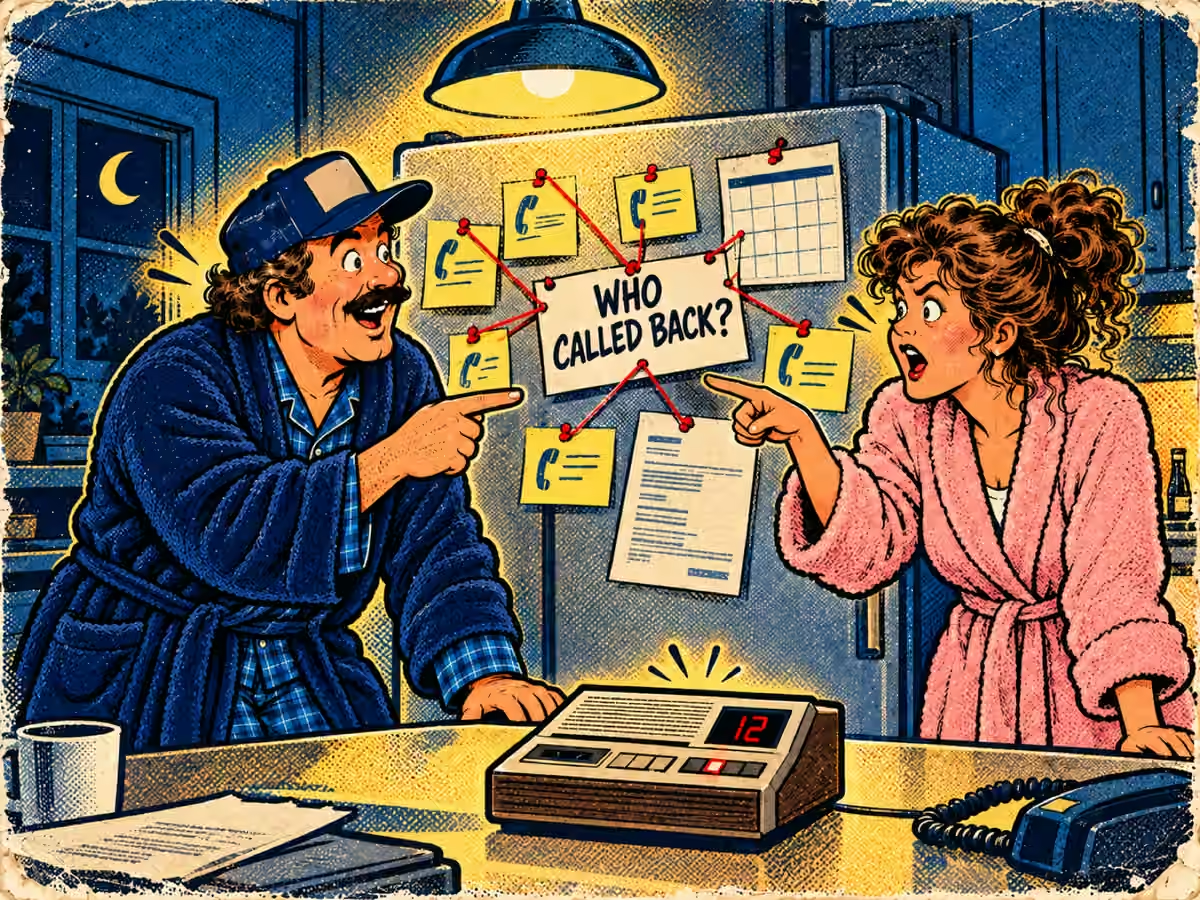
July. For the first time in three years you take the family away for a week. Phone in your pocket, you promised yourself you wouldn't look. Day two, you look. Six missed calls and a text from the office: "Some guy called about a patio. I told him around $15K, he said he'd think about it." What guy? What patio? Did you get his number? "I think he called from a different phone." You spend the rest of the trip on the hotel balcony with the phone glued to your ear.
The thought that follows is familiar: "Nobody sells it like I do." And it's true — as long as everything you know about selling lives only in your head. Your team isn't dumber than you. They just don't have what you have: knowing what to ask, when not to throw out a price, who needs a callback and where to write it down. Sounds too simple? Let's take it apart step by step.
Sound familiar?
📱You are the phone
- You're on a roof, on a job, behind the wheel — and you still answer, because if you don't, nobody will.
- Instead of dinner, you spend the evening returning every call you missed during the day. Half of them already booked someone else.
- The crew stands around waiting because you've been on the phone all morning instead of on site.
🗣️The team answers — and loses it
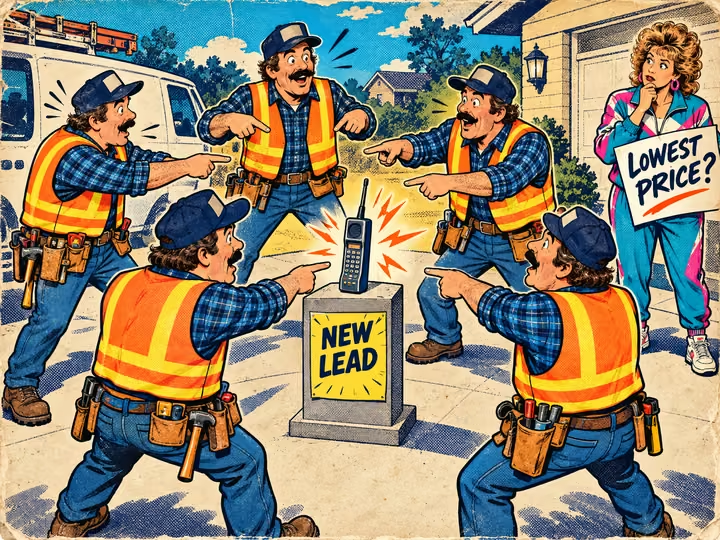
- Someone quotes a price over the phone without seeing the job. The homeowner hears "$15K" and goes with the company that came out and looked first.
- "I'll call you back" — and nobody does. Not on purpose: they forgot, got busy, figured someone else had it.
- The call happened, but there's no record of it. No name, no address, no idea what they wanted.

🏖️Vacation is a luxury
- You can't remember the last time your phone was off for more than a day.
- Your family is used to "Dad's on a call," even at your kid's birthday party.
- Every time you're sick or out of town, the month comes in short — and you can see it in the bank account.

🧠It all lives in your head
- Who got a quote, who's waiting on a call, who asked you to follow up after the holidays — only you know. It's somewhere in your phone, on sticky notes and in your memory.
- You want to add a second or third crew, but you know you physically can't handle more leads.
- And the worst part: you can't say how many leads the team dropped last month. Because nobody counted.
If this hits home, it's not that you're unlucky with people. You built the business with your own hands and your own phone, and it worked — up to a certain size. At $10K a month, an owner can keep sales in his head. At $40K, he can't: there are too many leads and only one head. That's not your mistake. It's the ceiling of the model you grew up on.
Why the usual fixes don't get sales off your plate
"I'll hire a good salesperson and let them figure it out"
Makes sense: hire someone who knows how to sell and hand them the phone. But even a strong salesperson walks into your business empty-handed. They don't know why your concrete costs more than the guy down the street's, what to ask about the property, when it's OK to give a number and when to just book the estimate. They'll sell their way, you'll keep correcting them, and three months later you're back on the phone — only now you're also paying a salary.
"My wife (or the office) will take the calls"
That's how most family companies grow, and there's nothing wrong with it. What breaks isn't the person — it's the hand-off. "I wrote it on a notepad." "I thought you called him back." Without shared rules, two people on one phone line lose more leads than one. Each is sure the next step is the other's job.
"I'll get a CRM and that'll fix it"
Software is a filing cabinet. If nobody agreed which drawer things go in and who checks them, it fills up with junk in a month. A CRM works when every lead has a task on it — who does what, by when — and someone looks once a week at what didn't get done. Without that, it's an expensive address book.
"I'll just keep answering myself and push harder"
You can. But then your company's revenue is forever capped at how many calls you can take between jobs. You're the ceiling. And when you call back three hours later, the homeowner has moved on. A Harvard Business Review study that audited 2,241 U.S. companies found that firms that reached out within an hour were nearly 7 times more likely to have a real conversation with the lead than firms that waited even one hour longer. The study is more than a decade old, and customers haven't gotten any more patient since.
"I just need more leads"
If the team is dropping leads now, doubling the flow doubles the losses. And if your ads bring in cheap leads — people calling five companies for the lowest price — the team drowns in dead-end calls and the good customers get lost among them. Plenty of agencies sell exactly that: lots of leads, cheap. I care about leads that turn into jobs. The ads and the website explain up front why your company is worth the money, so the people who call want results, not the lowest bid.
What you do when you sell it yourself
Look at what happens automatically when you're the one on the phone. You ask three or four questions and know right away whether it's your kind of job. You don't throw out a blind number — you explain what drives the price and offer to come take a look. You remember who you promised to call back. You know you need to follow up after the quote. None of that is talent. It's a set of habits you built over years.
Handing off sales means pulling those habits out of your head and turning them into rules, tools and owners. Same as on a job site: you don't set every post yourself. The crew has a plan, the tools, a lead guy and a clear result by the end of the day, and you swing by to check. Sales works the same way. The plan is the script. The tools are a CRM with tasks. The lead guy is whoever owns each step. The check is fifteen minutes of numbers once a week.
A system where sales run without you
- A first-call script — which questions to ask, how to tell whether it's your customer, what to say to "how much?" without a blind number, and how to book the estimate. A new hire sounds confident in the first week.
- A CRM where every lead is a card with a task — calls, website forms, texts all land in one place. Every card has a next step and a due date. Nothing lives on sticky notes.
- Lead-handling rules — how fast we respond, what the homeowner gets if nobody picks up (a missed-call text-back the moment the call ends), who covers evenings and weekends, when we call again after a quote.
- An owner for every step — who takes the lead, who runs the estimate, who sends the quote, who follows up after it. One name per step, not "one of us."
- Fifteen minutes of numbers once a week — leads, estimates, quotes, signed jobs, cost per job. You see where things get stuck, and the conversation is about numbers, not "I feel like."
Notice there's no superstar salesperson in this system. It's built for regular people who sometimes forget and get tired. So anything that can be forgotten, the CRM reminds them about, and anything that can be said wrong is already in the script.
For nights and weekends, you can add an AI receptionist: a voice assistant that answers calls 24/7, asks the script questions and books the estimate. It doesn't transfer calls to a live person — its job is to make sure the 9 p.m. caller doesn't go to whoever answered first, and that your team starts the morning with a booked appointment.
About "how much does it cost?"
This is where teams lose the most jobs. The homeowner asks for a price in the first thirty seconds. Your person doesn't want to sound evasive, so they throw out a number. If it's high, the homeowner gets scared without knowing what's included. If it's low, you're "suddenly" more expensive at the estimate, and the trust is gone.
A good script doesn't hide the price and doesn't fudge it. It explains what drives the number — size, materials, the condition of the property — can give an honest range based on similar jobs, and moves straight to the next step: "To give you an exact number, we need to see it. I can get you on the schedule Thursday at 10 a.m. or 3 p.m." The homeowner gets an answer, and the conversation doesn't end on a number. That's how your company's value comes through before anyone even pulls into the driveway.
The vacation test: 7 questions
Imagine you leave for two weeks and turn your phone off
- Who picks up when a new customer calls? What about Saturday night?
- What does the homeowner hear when they ask "how much?" — and would two of your people say the same thing?
- Two weeks later, where do you find a list of everyone who called and what happened with each of them?
- Who owns the quotes you sent before you left, and when will they follow up?
- If a call is missed, does the homeowner get a text that same minute?
- When you get back, can you tell in 15 minutes how many leads, estimates and signed jobs there were?
- Is even one sales rule in your company written down — on paper or in the CRM, not in your head?
If you have a specific answer with a person's name for 5–7 of these, you already have a system — it just needs tightening. For 2–4, sales depend on you and one other person, and every time that person is sick or quits, it costs you. For 0–1, the business can't run without you, and growth will hit the hours in your day long before it hits your ad budget.
Who I am and why I do this

I’m Eddie A. For 12+ years I’ve worked in marketing and sales: projects in 50+ industries, ad budgets up to $60,000 a month, and $12M+ in revenue attributed to campaigns I managed — in the U.S., Canada, the UAE, Turkey, Europe and Kazakhstan. I’m based in Apopka, Florida, and run a registered LLC.
- 12+years in marketing and sales
- 50+industries I’ve run ads for
- $60Kmax monthly ad budget
- $12M+revenue from my campaigns
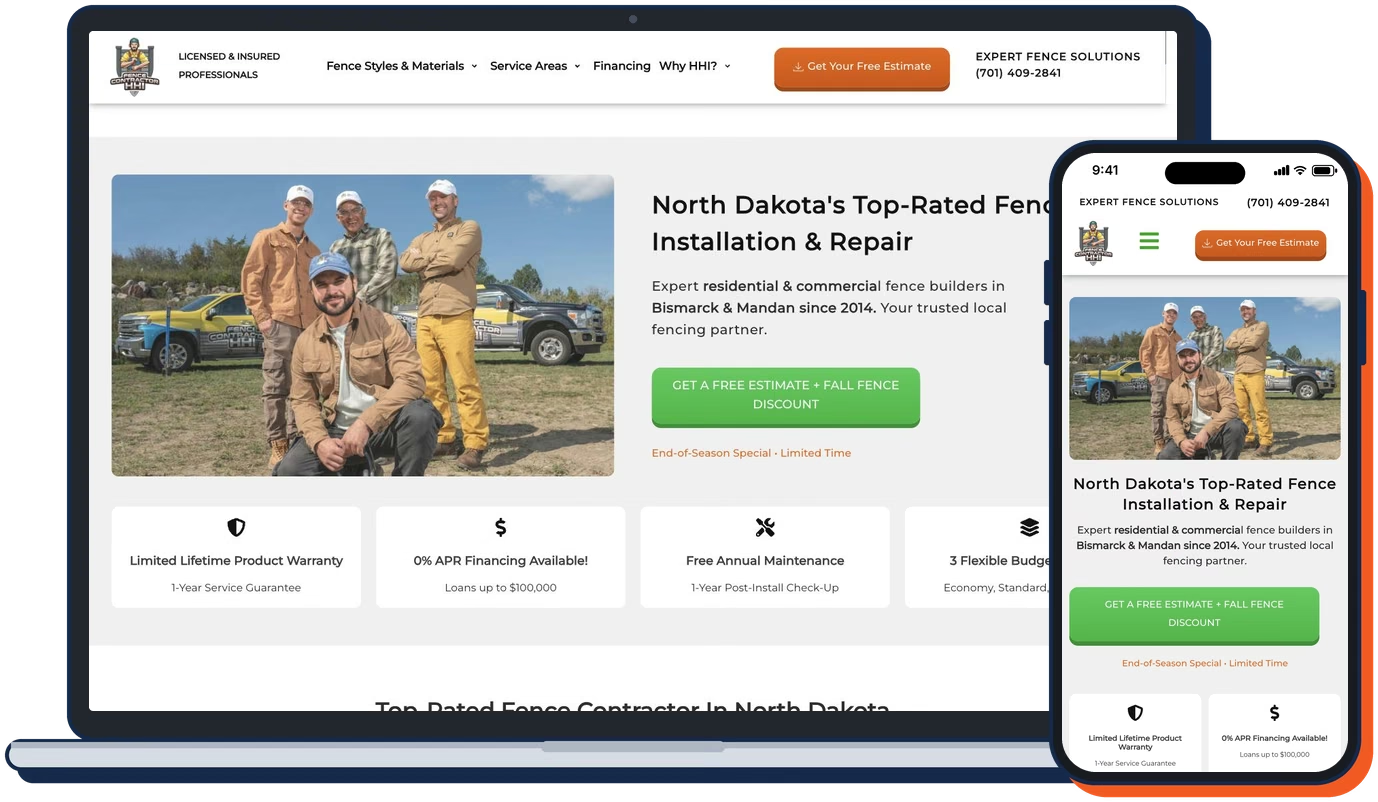
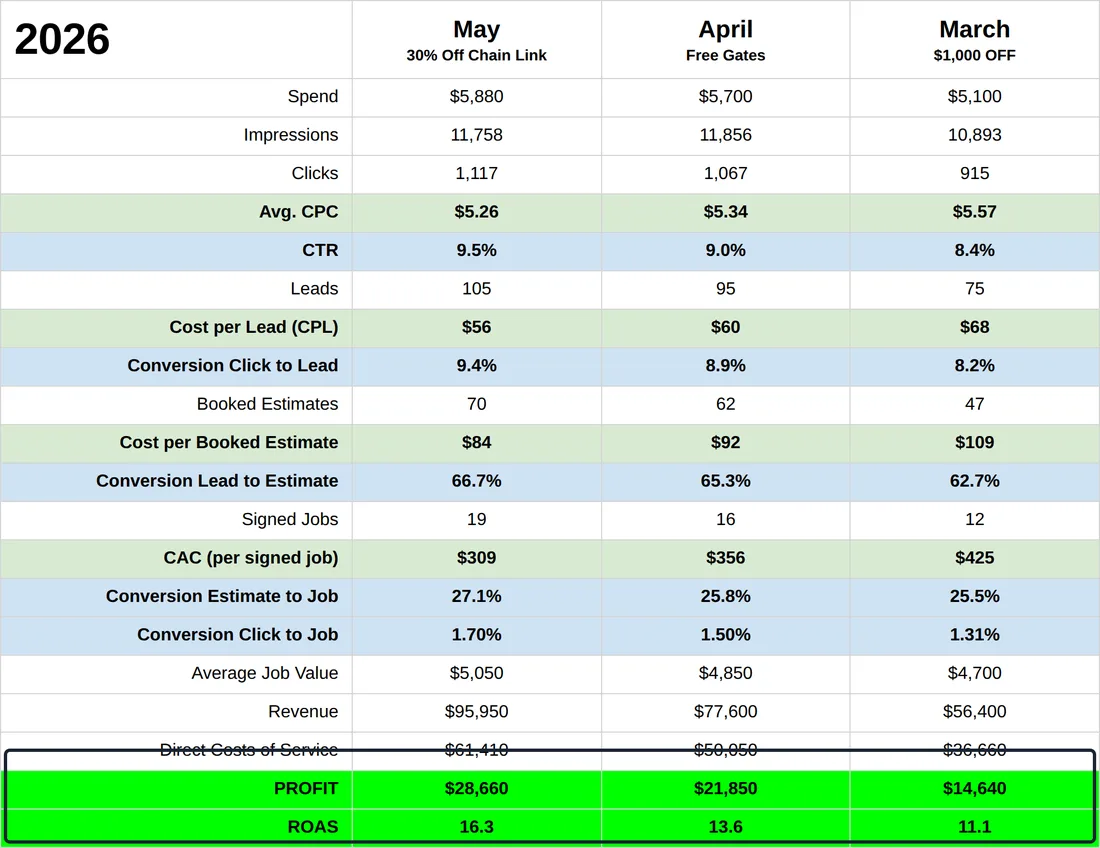
One example from home services: a fence company in North Dakota. In May 2026 a lead cost about $56, two out of three leads (67%) turned into a booked estimate, and each new customer cost $309 on an average job of about $5,000. There was no magic ad. The ads and the website showed why this company was worth choosing, every lead got a reply within minutes, every step had an owner, and no estimate was left without a next step.
I work alone — no account managers, no junior team. You always talk to me. I don’t just run ads: I build the sales side too — call scripts, follow-up messages, email templates — and I own how many leads turn into estimates and paid jobs.
Get sales off your shoulders
Done for you: work with me
A good fit if
- the business already makes steady money and you want to grow, not experiment;
- you’d rather be on jobs than learning ad platforms, websites and automations;
- you can put about $2,000 a month into marketing, ad spend included.
What I do
- Leads that turn into jobs. Your ads and website show why your company is worth the money — your work, your process, what’s included, your warranty, your reviews — so the people who reach out want results, not the lowest bid.
- Google and Meta ads — live in 3 days.
- A website or a page for your service — with a clear “book an estimate” button.
- No lead slips through — instant text and email after every lead, missed-call text-back, estimate booking, reminders after the quote.
- A sales system — call scripts, quote and email templates, rules for whoever answers the phone.
How I work
- No contracts. Pay by the week; stop any week.
- Everything is yours. Domain, website, ad accounts and customer list are in your name from day one.
- Reports in jobs: leads, booked estimates, quotes, paid jobs and what each job cost.
- You work directly with me. No account managers.
- No promised lead counts — I own the quality of the setup, the speed and honest numbers.
What changes
A call on the job site no longer pulls you off the ladder: whoever owns it picks up and follows the script. A missed call gets a text within a minute, not silence. On Monday you open the CRM and see a list instead of chaos: who has an estimate, who got a quote, who's due for a follow-up. On Friday, fifteen minutes on the numbers, and you can see where jobs get stuck. And vacation goes back to being a vacation, not a work trip to a hotel balcony.
Promising you a specific number up front wouldn't be honest — it depends on your trade, your market, your team and what actually gets implemented. But the leads that slip away today between "I'll call him back" and "I thought you called him" will stop disappearing quietly. You'll see them in the numbers.
Who this isn't for
- If you work solo and want to keep it that way. You need missed-call text-back and automatic follow-up more than team playbooks.
- If you're not ready to let go of the phone. The system works when the owner stops grabbing every call, even if the team doesn't sound exactly like him for the first few weeks.
- If you're looking for someone who'll "just sell" with no rules and no check-ins. That person doesn't exist — not for you, and not for your competitors.
Questions owners ask
My people just aren't salespeople
They don't need to sell like you. They need a script: what to ask, what to say to “how much?”, how to book the estimate. With one, a regular employee sounds more confident within a couple of weeks than an owner answering on the run from a roof.
It's easier to just do it all myself
It is — while leads are slow. But then your revenue is capped at how many calls you can take between jobs. You write the scripts and rules once and use them every day.
I already have a CRM and nobody uses it
Very common. A CRM comes alive when every lead has a task with an owner and a due date, and someone checks once a week what didn't get done. Start with the rules, not a new piece of software.
My wife answers the phones. Does she really need rules?
Especially her. Most leads aren't lost by strangers — they're lost in the hand-off between people who trust each other: “I thought you called him back.” Shared rules end those arguments and save some peace at home, too.
What does it cost?
Call scripts are $790, scripts plus automatic follow-up are $1,990, and a done-for-you sales system is $2,500 (50% upfront). Lead tracking with automatic replies starts at $69 a week. No long-term contracts — you pay by the week for ongoing work.
How long does the hand-off take?
The full system — website, CRM, automatic replies, scripts — takes about 4 weeks to build. Team habits take longer to change, which is why the weekly numbers check matters: it shows where the rules already work and where people still do it the old way.
Who will I be working with?
Me. I work alone — no account managers, no junior team. Your website, domain, ad accounts and customer list are in your name from day one.